Learning from routine health system data builds better neuroimaging AI models - Nature
High confidence: full text extraction produced 2904 characters.
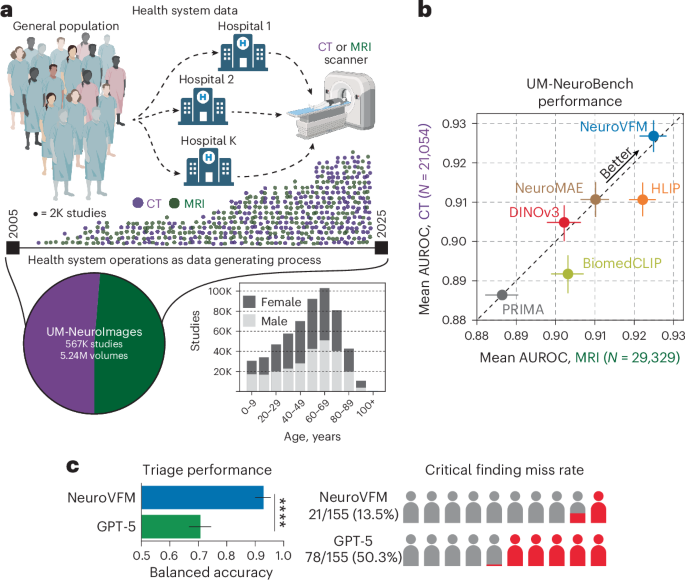
We trained a three-dimensional visual foundation model directly on 5.24 million routine clinical computed tomography (CT) and magnetic resonance imaging (MRI) image series so that it learned a shared representation of neuroanatomy and disease. The model demonstrated state-of-the-art diagnosis, in contrast to foundation models that are trained on public Internet and medical data, and enabled preliminary report generation and triage in real health systems.
Access options
Access Nature and 54 other Nature Portfolio journals
Get Nature+, our best-value online-access subscription
27,99 € / 30 days
cancel any time
Subscribe to this journal
Receive 12 print issues and online access
269,00 € per year
only 22,42 € per issue
Buy this article
39,95 €
Prices may be subject to local taxes which are calculated during checkout
References
- Radford, A. et al. Learning transferable visual models from natural language supervision. In Proc. 38th International Conference on Machine Learning 8748–8763 (2021). This paper established contrastive image-text pretraining (CLIP) as a foundation for modern vision-language models.
- Jiang, L. Y. et al. Health system-scale language models are all-purpose prediction engines. Nature 619, 357–362 (2023). This study demonstrated that large-scale health system data can support broadly useful clinical prediction models.
- Assran, M. et al. Self-supervised learning from images with a joint-embedding predictive architecture. In Proc. IEEE/CVF Conference on Computer Vision and Pattern Recognition (CVPR) 15619–15629 (2023). This paper introduced I-JEPA, the self-supervised representation learning method adapted here for volumetric medical imaging.
- Lyu, Y. et al. Learning neuroimaging models from health system-scale data. Nat. Biomed. Eng. https://doi.org/10.1038/s41551-025-01608-0 (2026). This paper showed strong performance with neuroimaging learning from MRI–report pairs at health system scale.
- Moor, M. et al. Foundation models for generalist medical artificial intelligence. Nature 616, 259–265 (2023). This perspective outlines the rationale for generalist medical AI models that learn across heterogeneous clinical data modalities and support multiple downstream tasks.
Additional information
Publisher’s note Springer Nature remains neutral with regard to jurisdictional claims in published maps and institutional affiliations.
This is a summary of: Kondepudi, A. et al. Health system learning enables generalist neuroimaging models. Nat. Med. https://doi.org/10.1038/s41591-026-04497-1 (2026).
A.K. and T.H. used ChatGPT to help prepare their contribution to this Research Briefing.
About this article
Cite this article
Learning from routine health system data builds better neuroimaging AI models. Nat Med (2026). https://doi.org/10.1038/s41591-026-04567-4
- Published:
- Version of record:
- DOI: https://doi.org/10.1038/s41591-026-04567-4