Agentic AI for scaling diagnosis and care in neurodegenerative disease - Nature
High confidence: full text extraction produced 23006 characters.
Abstract
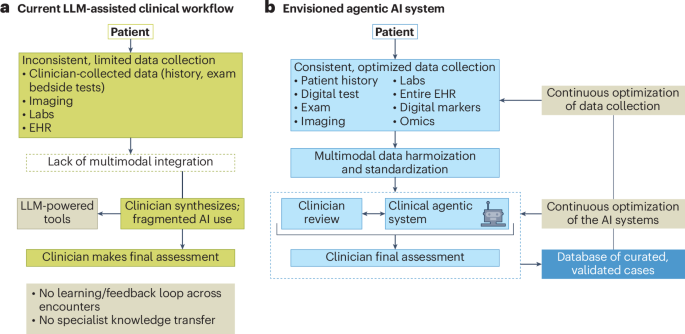
US healthcare systems are struggling to meet the growing demand for neurological care, particularly in Alzheimer’s disease and related dementias. Generative artificial intelligence (AI) built on large language models now enables agentic AI systems that can streamline clinical workflows, integrate multimodal data and learn from practicing specialists. We envision an agentic AI system that scales specialist-level care to nonspecialist clinical settings through a continuously learning healthcare system. We describe this destination and outline a phased roadmap for responsible design and integration into care of Alzheimer’s disease and related dementias: (1) high-quality standardized data collection across modalities; (2) decision support; (3) clinical integration enhancing workflows; (4) rigorous validation and monitoring protocols; (5) continuous learning through clinical feedback; and (6) robust ethics and risk management frameworks. This human-centered approach optimizes clinicians’ capabilities in comprehensive data collection, interpretation of complex clinical information and timely application of relevant medical knowledge while prioritizing patient safety, healthcare equity and transparency.
Access options
Access Nature and 54 other Nature Portfolio journals
Get Nature+, our best-value online-access subscription
27,99 € / 30 days
cancel any time
Subscribe to this journal
Receive 12 digital issues and online access to articles
118,99 € per year
only 9,92 € per issue
Buy this article
39,95 €
Prices may be subject to local taxes which are calculated during checkout
References
- Hebert, L. E., Weuve, J., Scherr, P. A. & Evans, D. A. Alzheimer disease in the United States (2010–2050) estimated using the 2010 census. Neurology 80, 1778–1783 (2013).
- GBD 2016 Neurology Collaborators. Global, regional, and national burden of neurological disorders, 1990–2016: a systematic analysis for the Global Burden of Disease Study 2016. Lancet Neurol. 18, 459–480 (2019).
- Fang, M. et al. Lifetime risk and projected burden of dementia. Nat. Med. https://doi.org/10.1038/s41591-024-03340-9 (2025).
- Bradford, A., Kunik, M. E., Schulz, P., Williams, S. P. & Singh, H. Missed and delayed diagnosis of dementia in primary care: prevalence and contributing factors. Alzheimer Dis. Assoc. Disord. 23, 306–314 (2009).
- Kotagal, V. et al. Factors associated with cognitive evaluations in the United States. Neurology 84, 64–71 (2015).
- Babulal, G. M. et al. Perspectives on ethnic and racial disparities in Alzheimer’s disease and related dementias: update and areas of immediate need. Alzheimers Dement. 15, 292–312 (2019).
- Boustani, M. et al. Implementing a screening and diagnosis program for dementia in primary care. J. Gen. Intern. Med. 20, 572–577 (2005).
- Bernstein, A. et al. Primary care provider attitudes and practices evaluating and managing patients with neurocognitive disorders. J. Gen. Intern. Med. 34, 1691–1692 (2019).
- Majersik, J. J. et al. A shortage of neurologists – we must act now: a report from the AAN 2019 Transforming Leaders Program. Neurology 96, 1122–1134 (2021).
- Satiani, A., Niedermier, J., Satiani, B. & Svendsen, D. P. Projected workforce of psychiatrists in the United States: a population analysis. Psychiatr. Serv. 69, 710–713 (2018).
- Flaherty, E. & Bartels, S. J. Addressing the community-based geriatric healthcare workforce shortage by leveraging the potential of interprofessional teams. J. Am. Geriatr. Soc. 67, S400–S408 (2019).
- Liu, J. L. et al. Modeling early detection and geographic variation in health system capacity for Alzheimer’s disease-modifying therapies. RAND Corp. https://doi.org/10.7249/RRA2643-1 (2024).
- van Dyck, C. H. et al. Lecanemab in early Alzheimer’s disease. N. Engl. J. Med. 388, 9–21 (2023).
- Sims, J. R. et al. Donanemab in early symptomatic Alzheimer disease: the TRAILBLAZER-ALZ 2 randomized clinical trial. JAMA 330, 512–527 (2023).
- Guiding an Improved Dementia Experience (GUIDE) Model. CMS https://www.cms.gov/priorities/innovation/innovation-models/guide/ (accessed 18 April 2024).
- Singhal, K. et al. Large language models encode clinical knowledge. Nature 620, 172–180 (2023).
- Singhal, K. et al. Toward expert-level medical question answering with large language models. Nat. Med. https://doi.org/10.1038/s41591-024-03423-7 (2025).
- Tu, T. et al. Towards generalist biomedical AI. NEJM AI 1, AIoa2300138 (2024).
- Tu, T. et al. Towards conversational diagnostic artificial intelligence. Nature https://doi.org/10.1038/s41586-025-08866-7 (2025).
- Liu X., et al. A generalist medical language model for disease diagnosis assistance. Nat. Med. https://doi.org/10.1038/s41591-024-03416-6 (2025).
- American Medical Association Center for Digital Health and AI. 2026 Physician Survey on Augmented Intelligence 2026. ama-assn.org https://www.ama-assn.org/system/files/physician-ai-sentiment-report.pdf (2026).
- Gupta, R. et al. The shift from models to compound AI systems. The Berkeley Artificial Intelligence Research Blog https://bair.berkeley.edu/blog/2024/02/18/compound-ai-systems/ (2024).
- Acharya, D. B., Kuppan, K. & Divya, B. Agentic AI: autonomous intelligence for complex goals—a comprehensive survey. IEEE Access 13, 18912–18936 (2025).
- For trustworthy AI, keep the human in the loop. Nat Med. 31, 3207 (2025).
- Sheehy, L. et al. Development and initial testing of an artificial intelligence-based virtual reality companion for people living with dementia in long-term care. J. Clin. Med. 13, 5574 (2024).
- Ray, M. et al. Evaluating a large language model in translating patient instructions to spanish using a standardized framework. JAMA Pediatr. 179, 1026–1033 (2025).
- Tong, L. et al. Telemedicine and health disparities: Association between patient characteristics and telemedicine, in-person, telephone and message-based care during the COVID-19 pandemic. IPEM Transl. 3, 100010 (2022).
- Nota, S. P. F. T., Strooker, J. A. & Ring, D. Differences in response rates between mail, e-mail, and telephone follow-up in hand surgery research. Hand 9, 504–510 (2014).
- Pagán, V. M., McClung, K. S. & Peden, C. J. An observational study of disparities in telemedicine utilization in primary care patients before and during the COVID-19 pandemic. Telemed. J. E Health 28, 1117–1125 (2022).
- Hinton, L. et al. Practice constraints, behavioral problems, and dementia care: primary care physicians’ perspectives. J. Gen. Intern. Med. 22, 1487–1492 (2007).
- Qu, Y. & Wang, J. Performance and biases of large language models in public opinion simulation. Humanit. Soc. Sci. Commun. 11, 1–13 (2024).
- Van Veen, D. et al. Adapted large language models can outperform medical experts in clinical text summarization. Nat. Med. 30, 1134–1142 (2024).
- Breithaupt, A. G. et al. Enhancing early detection of cognitive impairment in primary care with the TabCAT-BHA. Alzheimers Dement. 21, e70437 (2025).
- Chen, L., Zhen, W. & Peng, D. Research on digital tool in cognitive assessment: a bibliometric analysis. Front. Psychiatry https://doi.org/10.3389/fpsyt.2023.1227261 (2023).
- Belleville, S., LaPlume, A. A. & Purkart, R. Web-based cognitive assessment in older adults: where do we stand?. Curr. Opin. Neurol. 36, 491–497 (2023).
- Mancuso, V. et al. Systematic review of memory assessment in virtual reality: evaluating convergent and divergent validity with traditional neuropsychological measures. Front. Hum. Neurosci. https://doi.org/10.3389/fnhum.2024.1380575 (2024).
- Breithaupt, A. G. et al. Review of artificial intelligence for clinical use in Alzheimer’s disease and related dementias. Semin. Neurol. https://doi.org/10.1055/a-2744-9871 (2025).
- Adnan, T. et al. AI-enabled Parkinson’s disease screening using smile videos. NEJM AI 2, AIoa2400950 (2025).
- Deng, D. et al. Interpretable video-based tracking and quantification of parkinsonism clinical motor states. NPJ Parkinsons Dis. 10, 122 (2024).
- Zhang, K. et al. Recent advances in compact portable platforms and gradient hardware for brain MRI. Radiology 315, e241904 (2025).
- Ashton, N. J. et al. Diagnostic accuracy of a plasma phosphorylated tau 217 immunoassay for Alzheimer disease pathology. JAMA Neurol. 81, 255–263 (2024).
- Janelidze, S. et al. Plasma phosphorylated Tau 217 and Aβ42/40 to predict early brain Aβ accumulation in people without cognitive impairment. JAMA Neurol. 81, 947–957 (2024).
- Palmqvist, S. et al. Blood biomarkers to detect Alzheimer disease in primary care and secondary care. JAMA https://doi.org/10.1001/jama.2024.13855 (2024).
- Arnold, M. R. et al. α-synuclein seed amplification in CSF and brain from patients with different brain distributions of pathological α-synuclein in the context of co-pathology and non-LBD diagnoses. Ann. Neurol. 92, 650–662 (2022).
- Gibbons, C. H. et al. Skin biopsy detection of phosphorylated α-synuclein in patients with synucleinopathies. JAMA 331, 1298–1306 (2024).
- Samudra, N. et al. Clinicopathological correlation of cerebrospinal fluid alpha-synuclein seed amplification assay in a behavioral neurology autopsy cohort. Alzheimers Dement. 20, 3334–3341 (2024).
- Bouwman, F. H. et al. Clinical application of CSF biomarkers for Alzheimer’s disease: from rationale to ratios. Alzheimers Dement. 14, e12314 (2022).
- Dubois, B. et al. Alzheimer disease as a clinical-biological construct—an International Working Group recommendation. JAMA Neurol. https://doi.org/10.1001/jamaneurol.2024.3770 (2024).
- Jasodanand, V. H., Bellitti, M. & Kolachalama, V. B. An AI-first framework for multimodal data in Alzheimer’s disease and related dementias. Alzheimers Dement. 21, e70719 (2025).
- Wilkinson, M. D. et al. The FAIR Guiding principles for scientific data management and stewardship. Sci. Data 3, 160018 (2016).
- Shah, N. H. et al. A nationwide network of health ai assurance laboratories. JAMA 331, 245–249 (2024).
- HL7 International. FHIR R5: fast healthcare interoperability resources. hl7.org https://www.hl7.org/fhir/index.html (2023).
- SMART Health IT. smarthealthit.org https://smarthealthit.org/ (accessed 25 October 2025).
- Oracle Health. Oracle Health Millennium Platform APIs. oracle.com https://docs.oracle.com/en/industries/health/millennium-platform-apis/index.html (2025).
- Epic Systems. Epic’s home for data sharing and developer tools. epic.com https://open.epic.com/ (2025).
- Brown, E. G. et al. Enhancing clinical information display to improve patient encounters: human-centered design and evaluation of the Parkinson Disease-BRIDGE platform. JMIR Hum. Factors 9, e33967 (2022).
- Park, W. Y. et al. Breaking data silos: incorporating the DICOM imaging standard into the OMOP CDM to enable multimodal research. J. Am. Med. Inform. Assoc. 32, 1533–1541 (2025).
- Lau-Min, K. S. et al. Impact of integrating genomic data into the electronic health record on genetics care delivery. Genet. Med. 24, 2338–2350 (2022).
- Hoffman, S. L. et al. Comprehensive real time remote monitoring for Parkinson’s disease using quantitative DigitoGraphy. NPJ Parkinsons Dis. 10, 137 (2024).
- McHugh, C. P., Clement, M. H. S. & Phatak, M. AD Workbench: transforming Alzheimer’s research with secure, global, and collaborative data sharing and analysis. Alzheimers Dement. 21, e70278 (2025).
- Brat, G. A., Mandel, J. C. & McDermott, M. B. A. Do we need data standards in the era of large language models?. NEJM AI 1, AIe2400548 (2024).
- Savage, T., Nayak, A., Gallo, R., Rangan, E. & Chen, J. H. Diagnostic reasoning prompts reveal the potential for large language model interpretability in medicine. NPJ Digit. Med. 7, 20 (2024).
- Esteva, A. et al. A guide to deep learning in healthcare. Nat. Med. 25, 24–29 (2019).
- Bron, E. E. et al. Standardized evaluation of algorithms for computer-aided diagnosis of dementia based on structural MRI: the CADDementia challenge. Neuroimage 111, 562–579 (2015).
- Xue, C. et al. AI-based differential diagnosis of dementia etiologies on multimodal data. Nat. Med. 30, 2977–2989 (2024).
- Rauschecker, A. M. et al. Artificial intelligence system approaching neuroradiologist-level differential diagnosis accuracy at brain MRI. Radiology 295, 626–637 (2020).
- Leming, M. & Im, H. Differential dementia detection from multimodal brain images in a real-world dataset. Alzheimers Dement. 21, e70362 (2025).
- Qiu, S. et al. Multimodal deep learning for Alzheimer’s disease dementia assessment. Nat. Commun. 13, 3404 (2022).
- Jasodanand, V. H. et al. AI-driven fusion of multimodal data for Alzheimer’s disease biomarker assessment. Nat. Commun. 16, 7407 (2025).
- Tanabe, J. et al. Automated volumetric software in dementia: help or hindrance to the neuroradiologist?. AJNR Am. J. Neuroradiol. 45, 1737–1744 (2024).
- Haller, S. et al. Basic MR sequence parameters systematically bias automated brain volume estimation. Neuroradiology 58, 1153–1160 (2016).
- Wittens, M. M. J. et al. Diagnostic performance of automated MRI volumetry by icobrain dm for Alzheimer’s disease in a clinical setting: a REMEMBER study. J. Alzheimers Dis. 83, 623–639 (2021).
- Yu, K. H., Beam, A. L. & Kohane, I. S. Artificial intelligence in healthcare. Nat. Biomed. Eng. 2, 719–731 (2018).
- Aristidou, A., Jena, R. & Topol, E. J. Bridging the chasm between AI and clinical implementation. Lancet 399, 620 (2022).
- Schubert, M. C., Wick, W. & Venkataramani, V. Performance of large language models on a neurology board–style examination. JAMA Netw. Open 6, e2346721 (2023).
- Koga, S., Martin, N. B. & Dickson, D. W. Evaluating the performance of large language models: ChatGPT and Google Bard in generating differential diagnoses in clinicopathological conferences of neurodegenerative disorders. Brain Pathol. 34, e13207 (2023).
- Ayers, J. W. et al. Comparing Physician and artificial intelligence chatbot responses to patient questions posted to a public social media forum. JAMA Intern. Med. 183, 589–596 (2023).
- Gallingani, C. et al. Agentic generative artificial intelligence system for classification of pathology-confirmed primary progressive aphasia variants. Preprint at medRxiv https://doi.org/10.1101/2025.10.28.25338977 (2025).
- Saab, K., Park, C. & Strother, T. et al. Advancing conversational diagnostic AI with multimodal reasoning. Nat. Med. 32, 1726–1736 (2026).
- Saab, K. et al. Advancing conversational diagnostic AI with multimodal reasoning. Preprint at https://arxiv.org/abs/2505.04653 (2025).
- El Arab, R. A. & Al Moosa, O. A. Systematic review of cost effectiveness and budget impact of artificial intelligence in healthcare. NPJ Digit. Med. 8, 548 (2025).
- Aye, S., Handels, R., Winblad, B. & Jönsson, L. Optimising Alzheimer’s disease diagnosis and treatment: assessing cost-utility of integrating blood biomarkers in clinical practice for disease-modifying treatment. J. Prev. Alzheimers Dis. 11, 928–942 (2024).
- Bharadwaj, P. et al. Unlocking the value: quantifying the return on investment of hospital artificial intelligence. J. Am. Coll. Radiol. 21, 1677–1685 (2024).
- Stanford HAI. The 2025 AI Index Report. hai.stanford.edu https://hai.stanford.edu/ai-index/2025-ai-index-report/ (accessed 11 October 2025).
- Parikh, R. B. & Helmchen, L. A. Paying for artificial intelligence in medicine. NPJ Digit. Med. 5, 63 (2022).
- Peterson Health Technology Institute. Adoption of artificial intelligence in healthcare delivery systems: early applications and impacts. phti.org https://phti.org/ai-adoption-early-applications-impacts/ (2025).
- Tardo, L. et al. Evaluation of the impact of neurology electronic consults (e-consults): experiences of a neurology resident clinic in a safety-net hospital. J. Telemed. Telecare 31, 1270–1277 (2025).
- Bedi, S. et al. Testing and evaluation of health care applications of large language models: a systematic review. JAMA https://doi.org/10.1001/jama.2024.21700 (2024).
- The Federal Register/FIND. Health data, technology, and interoperability: certification program updates, algorithm transparency, and information sharing. Vol 89, 1192. proquest.com https://www.proquest.com/docview/2912085944/citation/14F0AB28E9DD4318PQ/1 (2024).
- Goh, E. et al. Large language model influence on diagnostic reasoning: a randomized clinical trial. JAMA Netw. Open 7, e2440969 (2024).
- Jabbour, S. et al. Measuring the impact of AI in the diagnosis of hospitalized patients: a randomized clinical vignette survey study. JAMA 330, 2275–2284 (2023).
- Tonmoy, S. M. et al. A comprehensive survey of hallucination mitigation techniques in large language models. Preprint at http://arxiv.org/abs/2401.01313 (2024).
- Bucher, M. J. J. & Martini, M. Fine-tuned ‘small’ LLMs (still) significantly outperform zero-shot generative ai models in text classification. Preprint at https://arxiv.org/html/2406.08660v1 (2024).
- Hugging Face. Open Medical-LLM Leaderboard - a Hugging Face Space by openlifescienceai. huggingface.co https://huggingface.co/spaces/openlifescienceai/open_medical_llm_leaderboard/ (accessed 13 November 2024).
- Dettmers, T., Pagnoni, A., Holtzman, A. & Zettlemoyer, L. QLORA: efficient finetuning of quantized LLMs. In Proc. 37th Int. Conf. on Neural Information Processing Systems. NIPS ’23 (eds. Oh, A. et al.) 10088–10115 (Curran Associates Inc., 2023).
- Abadir, P. M., Battle, A., Walston, J. D. & Chellappa, R. Enhancing care for older adults and dementia patients with large language models: proceedings of the National Institute on Aging—Artificial Intelligence & Technology Collaboratory for Aging Research Symposium. J. Gerontol. A Biol. Sci. Med. Sci. 79, glae176 (2024).
- Obermeyer, Z., Powers, B., Vogeli, C. & Mullainathan, S. Dissecting racial bias in an algorithm used to manage the health of populations. Science 366, 447–453 (2019).
- Leslie, D., Mazumder, A., Peppin, A., Wolters, M. K. & Hagerty, A. Does ‘AI’ stand for augmenting inequality in the era of COVID-19 healthcare?. BMJ 372, n304 (2021).
- Savulescu, J., Giubilini, A., Vandersluis, R. & Mishra, A. Ethics of artificial intelligence in medicine. Singapore Med. J. 65, 150–158 (2024).
- US Department of Health and Human Services. IRB considerations on the use of artificial intelligence in human subjects research. hhs.gov https://www.hhs.gov/ohrp/sachrp-committee/recommendations/irb-considerations-use-artificial-intelligence-human-subjects-research/index.html (2022).
- Sarkar AR, Chuang YS, Mohammed N, Jiang X. De-identification is not enough: a comparison between de-identified and synthetic clinical notes. Sci Rep. 2024;14(1):29669. https://doi.org/10.1038/s41598-024-81170-y
- Broniatowski, D. A. Psychological foundations of explainability and interpretability in artificial intelligence. National Institute of Standards and Technology (US); NIST IR 8367. NIST https://doi.org/10.6028/NIST.IR.8367 (2021).
- Tabassi, E. Artificial Intelligence Risk Management Framework (AI RMF 1.0). National Institute of Standards and Technology (US); NIST AI 100-1. NIST https://doi.org/10.6028/NIST.AI.100-1 (2023).
- Phillips, P. J. et al. Four principles of explainable artificial intelligence. National Institute of Standards and Technology (US); NIST IR 8312. NIST https://doi.org/10.6028/NIST.IR.8312 (2021).
- Sim, I. & Cassel, C. The ethics of relational AI — expanding and implementing the Belmont principles. N. Engl. J. Med. 391, 193–196 (2024).
- Mello, M. M. & Cohen, I. G. Regulation of health and health care artificial intelligence. JAMA 333, 1769–1770 (2025).
- Dell’Acqua, F. et al. Navigating the jagged technological frontier: field experimental evidence of the effects of AI on knowledge worker productivity and quality. SSRN Electron J. https://doi.org/10.2139/ssrn.4573321 (2023).
- Bedi, S., Fries, J. A. & Shah, N. H. How to interpret ‘zero-shot’ results from generative EHR models. Nat. Med. 32, 404–406 (2026).
- Shi, H. et al. Continual learning of large language models: a comprehensive survey. ACM Comput. Surv. 58, 120:1–120:42 (2025).
- Liu, N. F. et al. Lost in the middle: how language models use long contexts. Trans. Assoc. Comput. Linguist. 12, 157–173 (2024).
- Gargari, O. K. & Habibi, G. Enhancing medical AI with retrieval-augmented generation: a mini narrative review. Digit. Health https://doi.org/10.1177/20552076251337177 (2025).
- He, J. et al. Retrieval-augmented generation in biomedicine: a survey of technologies, datasets, and clinical applications. Preprint at https://arxiv.org/abs/2505.01146 (2025).
- Lopopolo, R. Harness engineering: leveraging Codex in an agent-first world. OpenAI https://openai.com/index/harness-engineering/ (accessed 27 April 2026).
- Lu, C. et al. Towards end-to-end automation of AI research. Nature 651, 914–919 (2026).
- Model Context Protocol. What is the Model Context Protocol (MCP)? modelcontextprotocol.io https://modelcontextprotocol.io/docs/getting-started/intro/ (accessed 27 April 2026).
Acknowledgements
A.G.B. is supported by the Alzheimer’s Association, Eisai and American Brain Foundation. P.V.H. and R.Z. are supported by NSF grant 2112533.
Author information
Authors and Affiliations
Contributions
All authors meet the ICMJE requirements for authorship through (1) substantial contributions to the conception of the work, (2) reviewing the work critically for important intellectual content, (3) final approval of the version to be published, and (4) agreement to be accountable for all aspects of the work in ensuring that questions related to the accuracy or integrity of any part of the work are appropriately investigated and resolved.
Corresponding authors
Ethics declarations
Competing interests
A.M.R reports receiving research funding from GE Healthcare. A.I.L. serves as a consultant and receives fees and/or stock from EmTheraPro (co-founder), NextSense, Alamar, Cognition Therapeutics, Cognito, Eratos and Asha. The other authors declare no competing interests.
Peer review
Peer review information
Nature Aging thanks Vijaya Kolachalama, Laia Montoliu-Gaya, Tengfei Guo and the other, anonymous, reviewer(s) for their contribution to the peer review of this work.
Additional information
Publisher’s note Springer Nature remains neutral with regard to jurisdictional claims in published maps and institutional affiliations.
Rights and permissions
Springer Nature or its licensor (e.g. a society or other partner) holds exclusive rights to this article under a publishing agreement with the author(s) or other rightsholder(s); author self-archiving of the accepted manuscript version of this article is solely governed by the terms of such publishing agreement and applicable law.
About this article
Cite this article
Breithaupt, A.G., Weiner, M., Tang, A. et al. Agentic AI for scaling diagnosis and care in neurodegenerative disease. Nat Aging (2026). https://doi.org/10.1038/s43587-026-01186-z
- Received:
- Accepted:
- Published:
- Version of record:
- DOI: https://doi.org/10.1038/s43587-026-01186-z