Reusability report: Exploring the utility and extensibility of an integrated modelling framework for liquid electrolyte design - Nature
High confidence: full text extraction produced 8452 characters.
Abstract
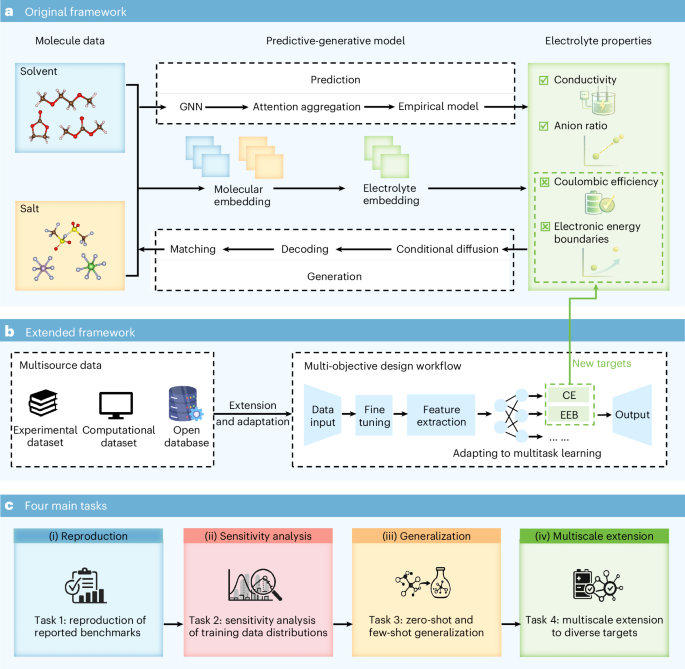
Despite rapid advances in machine learning-driven electrolyte design, the robustness, transferability and applicability of existing models remain insufficiently explored. Yang et al. recently introduced a unified machine learning framework for electrolyte formulation design. The framework adopts a physics-informed architecture that explicitly integrates molecular structural representations with formulation-level compositional information while preserving permutation invariance. By coupling forward property prediction with inverse generation, Yang et al. achieved accurate property prediction and efficient exploration of the formulation space. Here we present a systematic evaluation and multiscale extension of the framework proposed by Yang et al. We assess its robustness and reproducibility through rigorous benchmarking. We also reveal how training data size and compositional heterogeneity govern its applicability by quantifying its sensitivity to data distribution. Furthermore, we demonstrate cross-system transferability through zero-shot and few-shot learning across diverse operational regimes and novel electrolyte compositions. A multiscale extension of the framework has been implemented to encompass diverse targets, ranging from fundamental physical properties to electronic energy boundaries and battery Coulombic efficiency, where it substantially outperforms standard baselines. Overall, this work reveals both the potential and limitations of the framework proposed by Yang et al. across different systems and properties, and it establishes a reference for the reliable application and broader adoption of artificial intelligence-driven electrolyte design.
Access options
Access Nature and 54 other Nature Portfolio journals
Get Nature+, our best-value online-access subscription
27,99 € / 30 days
cancel any time
Subscribe to this journal
Receive 12 digital issues and online access to articles
118,99 € per year
only 9,92 € per issue
Buy this article
39,95 €
Prices may be subject to local taxes which are calculated during checkout
Data availability
The datasets used in this study are available via HuggingFace at https://huggingface.co/datasets/PKUAIBDA/Dataset_Bamboomixer_extension. All of the data used in the original paper for testing is available via HuggingFace at https://huggingface.co/ByteDance-Seed/bamboo_mixer.
Code availability
The original source code is available via Zenodo at https://doi.org/10.5281/zenodo.17694573 (ref. 24). Our extended framework used in this work is also available via Zenodo at https://doi.org/10.5281/zenodo.19048302 (ref. 25). The recommended default configurations are available via Zenodo at https://doi.org/10.5281/zenodo.19876420 (ref. 26).
References
- Wang, H. et al. Scientific discovery in the age of artificial intelligence. Nature 620, 47–60 (2023).
- Lam, H. Y. I. et al. Application of variational graph encoders as an effective generalist algorithm in computer-aided drug design. Nat. Mach. Intell. 5, 754–764 (2023).
- Fang, X. et al. Geometry-enhanced molecular representation learning for property prediction. Nat. Mach. Intell. 4, 127–134 (2022).
- Chen, X. et al. Uni-electrolyte: an artificial intelligence platform for designing electrolyte molecules for rechargeable batteries. Angew. Chem. 137, e202503105 (2025).
- Gong, S. et al. A predictive machine learning force-field framework for liquid electrolyte development. Nat. Mach. Intell. 7, 543–552 (2025).
- Jiang, B. et al. Deep active learning and knowledge transfer for rapid discovery of lithium metal battery electrolytes. Nat. Commun. 17, 5146 (2026).
- Kumar, R., Vu, M. C., Ma, P. & Amanchukwu, C. V. Electrolytomics: a unified big data approach for electrolyte design and discovery. Chem. Mater. 37, 2720–2734 (2025).
- Yao, N., Chen, X., Fu, Z.-H. & Zhang, Q. Applying classical, ab initio, and machine-learning molecular dynamics simulations to the liquid electrolyte for rechargeable batteries. Chem. Rev. 122, 10970–11021 (2022).
- Zhang, H. et al. Learning molecular mixture property using chemistry-aware graph neural network. PRX Energy 3, 023006 (2024).
- Yang, Z. et al. A unified predictive and generative solution for liquid electrolyte formulation. Nat. Mach. Intell. 8, 186–196 (2026).
- Tyler, C. et al. AI tools as science policy advisers? The potential and the pitfalls. Nature 622, 27–30 (2023).
- Hao, Q., Xu, F., Li, Y. & Evans, J. Artificial intelligence tools expand scientists’ impact but contract science’s focus. Nature 649, 1237–1243 (2026).
- Kailkhura, B., Gallagher, B., Kim, S., Hiszpanski, A. & Han, T. Y.-J. Reliable and explainable machine-learning methods for accelerated material discovery. NPJ Comput. Mater. 5, 108 (2019).
- Tang, Y., Tuncel, D., Koerner, C. & Runkler, T. The few-shot dilemma: over-prompting large language models. Preprint at https://arxiv.org/abs/2509.13196 (2025).
- Kim, S. C. et al. Data-driven electrolyte design for lithium metal anodes. Proc. Natl Acad. Sci. USA 120, e2214357120 (2023).
- Chen, C. et al. A critical review of machine learning of energy materials. Adv. Energy Mater. 10, 1903242 (2020).
- Dudley, J. et al. Conductivity of electrolytes for rechargeable lithium batteries. J. Power Sources 35, 59–82 (1991).
- Frisch, M. J. et al. Gaussian 16 Rev. C.01 (Gaussian Inc., 2016).
- Zhao, Y. & Truhlar, D. G. The M06 suite of density functionals for main group thermochemistry, thermochemical kinetics, noncovalent interactions, excited states, and transition elements: two new functionals and systematic testing of four M06-class functionals and 12 other functionals. Theor. Chem. Acc. 120, 215–241 (2007).
- Marenich, A. V., Cramer, C. J. & Truhlar, D. G. Universal solvation model based on solute electron density and on a continuum model of the solvent defined by the bulk dielectric constant and atomic surface tensions. J. Phys. Chem. B 113, 6378–6396 (2009).
- Spotte-Smith, E. W. C. et al. Quantum chemical calculations of lithium-ion battery electrolyte and interphase species. Sci. Data 8, 203 (2021).
- Lu, T. & Chen, F. Multiwfn: a multifunctional wavefunction analyzer. J. Comput. Chem. 33, 580–592 (2012).
- Lu, T. A comprehensive electron wavefunction analysis toolbox for chemists, Multiwfn. J. Chem. Phys. 161, 082503 (2024).
- Yang Z. et al. ByteDance-Seed/bamboo_mixer: v0.0.1. Zenodo https://doi.org/10.5281/zenodo.17694573 (2025).
- Lai G. et al. Bamboomixer_extension. Zenodo https://doi.org/10.5281/zenodo.19048302 (2026).
- Lai G. et al. Recommended parameters for Bamboomixer_extension. Zenodo https://doi.org/10.5281/zenodo.19876420 (2026).
Acknowledgements
We thank Z. Yang, S. Gong and W. Yan for their support with the code and data.
Funding
This work was supported by the Advanced Materials-National Science and Technology Major Project (2025ZD0618801), the National Natural Science Foundation of China (12426301), and AI for Science (AI4S)-Preferred Program, Peking University, Shenzhen, China.
Author information
Authors and Affiliations
Contributions
Conceptualization: G.L., J. Zheng and C.O. Methodology: G.L. and J. Zhao. Investigation: G.L., J. Zhao, Z.L., R.Z., H.L., Q.Z., F.R., C.F., Q.L., Y.Z., B.X., J. Zheng and C.O. Supervision: J. Zheng and C.O. Writing: G.L., J. Zhao, Y.Z., J. Zheng and C.O.
Corresponding authors
Ethics declarations
Competing interests
The authors declare no competing interests.
Peer review
Peer review information
Nature Machine Intelligence thanks Ying Wang and Kai Yang for their contribution to the peer review of this work.
Additional information
Publisher’s note Springer Nature remains neutral with regard to jurisdictional claims in published maps and institutional affiliations.
Rights and permissions
Springer Nature or its licensor (e.g. a society or other partner) holds exclusive rights to this article under a publishing agreement with the author(s) or other rightsholder(s); author self-archiving of the accepted manuscript version of this article is solely governed by the terms of such publishing agreement and applicable law.
About this article
Cite this article
Lai, G., Zhao, J., Liu, Z. et al. Reusability report: Exploring the utility and extensibility of an integrated modelling framework for liquid electrolyte design. Nat Mach Intell (2026). https://doi.org/10.1038/s42256-026-01277-x
- Received:
- Accepted:
- Published:
- Version of record:
- DOI: https://doi.org/10.1038/s42256-026-01277-x