Why the U.S. Must Simultaneously Compete—and Cooperate—With China on AI - Time Magazine
High confidence: full text extraction produced 5916 characters.
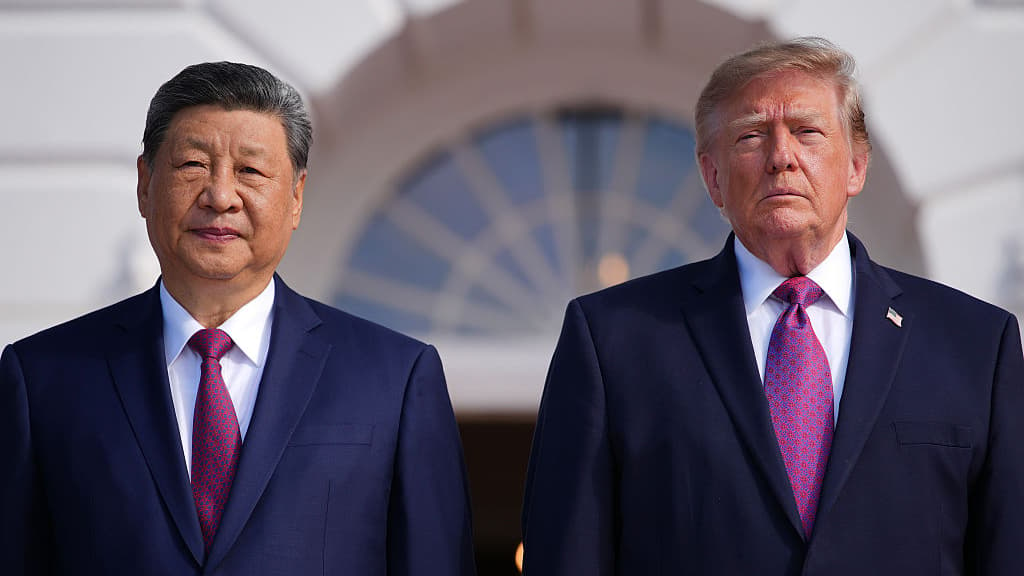
Last week, President Donald Trump hosted Chinese President Xi Jinping at the White House. It's their second meeting this year, following the May summit in Beijing. This visit, the stakes were even higher.
We have learned about security incidents from nearly every major AI company, American and Chinese, built on both open and closed models. The leading AI labs are openly debating whether to pace their frontier model development, and the government is working out what role it plays in that decision.
I spent four years as Secretary of Commerce focused intently on America’s economic, technological, and security competition with China—instituting first-of-its-kind export controls on the sale of chips and chipmaking equipment to China to protect our national security, and leading implementation of the CHIPS Act to onshore chip manufacturing. I also created the AI Safety Institute so we could accelerate our AI development responsibly and safely. I have sat across the table from China, and I have an understanding of how they think about AI.
I believe AI companies are right to want to pace the frontier. But we need to stay ahead of China while we pace, because a world where China leads the global AI competition threatens America’s interests.
The challenge is this: We need to outcompete China on the technology itself, while also working with China on addressing the risks posed by AI. Competition and cooperation are often in tension, but the stakes are too high in this case to pick only one.
How we cooperate—while staying ahead
China has its own reasons to take AI safety seriously. The Chinese Minister of State Security recently said publicly that the greatest risk advanced AI poses to China is the risk it poses to the stability of the Chinese Communist Party (CCP). Beijing is no more interested in powerful AI systems wreaking socio-political havoc than Washington is; both countries have incentives to align on certain safety standards or even just a shared understanding of AI risks. It is in neither country’s interest for companies to lose control of their AI systems or for AI to be used to create bioweapons by rogue actors. Treasury Secretary Scott Bessent’s announcement of a possible AI dialogue with Chinese counterparts after his meeting with Chinese Vice Premier He Lifeng is a tangible sign that China sees at least some space for cooperation here.
I would argue that now is the moment to fully establish that dialogue and keep the momentum going. We should do this by convening experts from both countries. I’m well aware that we’d be foolish to trust People's Republic of China (PRC) leaders. But that doesn’t mean we shouldn’t try. It just means we need to develop verification mechanisms to ensure agreements work even in the absence of trust.
Even if we don’t reach agreement on a shared set of standards, starting a dialogue and opening those lines of communication are critical—just as we did in 2008 during the financial crisis, when it was in our mutual benefit to coordinate. And we spent decades during the Cold War in careful, ongoing dialogue with the Soviet Union about nuclear arms control because the risks to both countries were enormous. During that time we developed zero-trust methods to verify arms control agreements even while locked in an adversarial relationship.
None of that changes the need to vigilantly and continuously update our controls as technology changes so China can’t access our most sophisticated compute in ways that threaten our national security. That includes continuously updating our export controls on leading-edge chips, addressing the risks of China accessing controlled compute remotely in data centers around the world, and cracking down on diversion of technology that is controlled.
We also need to tighten remaining gaps in our semiconductor manufacturing equipment controls so China can less capably obtain tools to manufacture powerful chips at scale and service their pre-existing equipment. That work has to happen with our Dutch, Japanese, and German allies and partners who manufacture and service this chipmaking equipment.
American AI
Finally, the U.S. government should put a greater burden on the AI companies to take adversarial distillation much more seriously. Distillation—coordinated, industrial-scale efforts by AI labs to train their weaker models on the outputs of frontier models—has become a significant issue in the past year. Anthropic has attributed more than 16 million Claude exchanges to distillation campaigns, and has estimated that over 3 million of these distillation campaigns can be traced back to China’s Moonshot AI (the company behind China’s version of ChatGPT, Kimi) along with other Chinese AI labs like Alibaba and DeepSeek. Moonshot, for instance, was later caught forwarding user prompts to Claude to answer and feeding those answers back through Kimi.
China has certainly indigenized much of its AI stack, something Xi publicly made a priority in his Made in China 2025 plan, many years before the U.S. government was talking openly about chips or models. And China has made progress on this plan. But it is clear to many that China’s most competitive models, to some degree, are ripping off American ones. American AI labs should be allocating even greater amounts of their money and compute towards finding and exposing this kind of activity so that policymakers—and the public—can adapt accordingly.
The risks and benefits of AI are enormous, something more and more Americans have come to realize as AI advances more quickly than we previously thought possible. There is much to do on AI safety at home, to ensure our society and economy are resilient to the dramatic changes AI will bring. But I also know that safe deployment of AI is only possible if we successfully manage our relationship with China—both by maintaining our technological lead and working towards collaboration.