Dean of faculty authorizes professors to use AI detector Pangram to review student work - The Dartmouth
High confidence: full text extraction produced 4413 characters.
On Sept. 29, interim dean of the faculty of Arts and Sciences and government professor John Carey sent an email to Dartmouth’s undergraduate faculty containing “guidelines on use of AI detection in teaching.” The guidelines permit faculty to input student work to artificial intelligence detector Pangram.
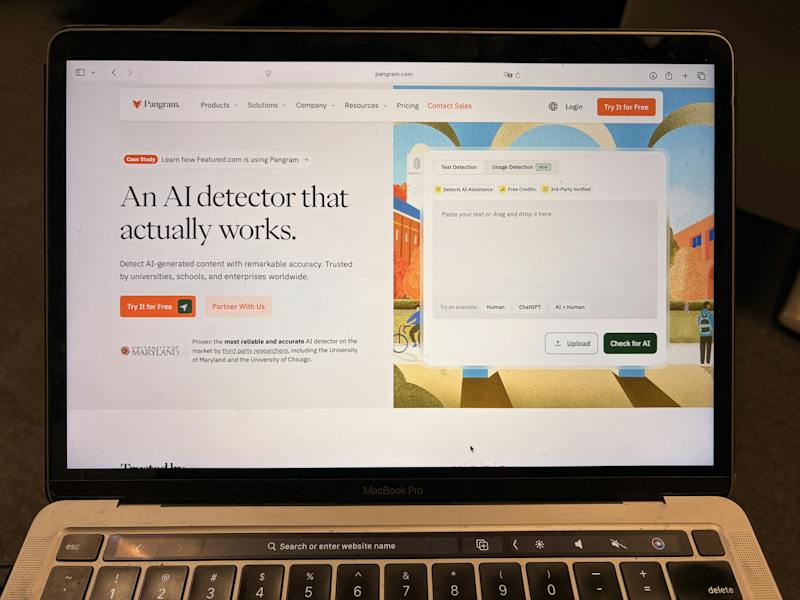
Pangram — which was found to have a “near-zero error rate” by an October 2025 University of Chicago audit — uses a large language model neural network that is trained to recognize differences between separate datasets of human-written documents and AI-generated content, according to the company’s website.
In the email, Carey wrote that AI detectors are “a topic the associate deans and I have been following for some time.”
“As the fall term approached, an increase in queries on the topic underscored for us that understandings varied among faculty regarding best practices and permissible practices at Dartmouth,” Carey wrote. “After we had begun developing these guidelines, the issue of AI use and detection became a central topic of conversation on our campus after reporting in The Dartmouth, The Boston Globe, The Chronicle of Higher Education and other outlets.”
A Semafor investigation into potential AI use in major newspapers’ opinion sections identified an Aug. 9 op-ed written by Provost Santiago Schnell as AI-generated. On Sept. 21, The Dartmouth reported that academic articles and opinion pieces published by Schnell in 2026 had a median “AI-written” text percentage of 96%. Coverage in The Chronicle of Higher Education, The Boston Globe and The New York Times followed.
Carey attached a document with seven “guidelines” on AI detection to his Sept. 29 email. The Dartmouth obtained and reviewed the document.
Instructions for AI detection of student work
The first guideline grants faculty permission to submit student writing to AI detectors to detect possible AI use. The second states that only Pangram is “authorized” for AI detection “because it has shown the most reliability of available detectors.”
The guidelines also state that faculty “must inform” students of course policies on AI, including whether the professor may use AI detectors and whether the “results of such assessments could affect grades.” Faculty are already “strongly encouraged” to define AI policies in their syllabi by the College’s “Guidelines on using Generative Artificial Intelligence (GenAI) for Coursework,” last revised in September 2025.
Student work must also be de-identified before submission to an AI detector, pursuant to the terms of the Family Educational Rights and Privacy Act of 1974, which protects students’ educational records.
The fifth guideline states that faculty must communicate with students before using the results of AI detection in “penalizing or otherwise affecting a student’s grade.” The sixth states the Committee on Standards will look at a “constellation” of “information beyond the result of an AI detection tool” before reaching a “finding of responsibility” in cases of suspected AI use.
The final guideline informs the faculty that the College is “evaluating” purchasing an institutional subscription to an AI detector, but that “no final decision” has been made.
Because AI is a “fast-moving technology,” there “may be reason to revise these guidelines in the future,” the guidelines state. “The Office of the Dean [of Faculty] will monitor developments in AI detection technology and will draw on ongoing consultation with: the Dartmouth Center for the Advancement of Learning, Learning Design and Innovation, Committee on Standards and the Committee on Organization and Policy” when considering further revisions.
In an interview with The Dartmouth, Carey said faculty “are not required” to use AI detectors. However, he and the associate deans “wanted to make sure that, when they do [use AI detectors], they have clarity about what they need to communicate to students, how they need to go about it and, critically, how to respect and protect data privacy,” Carey explained.
Senior associate provost for learning innovation Erin DeSilva declined to comment. Center for Advancement of Learning faculty director Robert Hawley did not respond to requests for comment. A College spokesperson did not respond to requests for comment.
Jackson Hyde ’28 is a reporter and editor. He is from Los Angeles, Calif., and is majoring in Government modified with Philosophy.