Why It's So Hard To Write About The RV Industry Without Accidentally Subjecting Readers To AI Slop - The Autopian
High confidence: full text extraction produced 10578 characters.
Artificial intelligence seems to be unavoidable in the online world today. Google forces it on you when you do a simple search. Facebook shoves generative AI in your face regardless of whether you want it or not. There’s also no shortage of people outsourcing their thinking and creativity to a computer. Now, the RV industry is slumping to the level of generative AI slop, and it’s making an already untrusted industry look even worse.
I have the rather unique position of straddling coverage of multiple industries at the same time. If you’re a longtime reader, you know that I have covered aviation, cars, motorcycles, trains, RVs, and the very occasional boat for about six years. Over that time, I’ve found that covering cars and motorcycles works largely similarly. Manufacturers produce press releases and image galleries, and media gets invited to try out new products. Car and motorcycle companies also have press vehicles. There are plenty of moto and car influencers, but also plenty of people who aren’t.
There was a time when the RV industry surprised me in how it doesn’t work like the car and motorcycle worlds. For some RV manufacturers, a “press release” might be a post on Facebook, or some video collaboration with an influencer. You’ll be lucky to get press imagery at all, and if you do, there’s a high chance that the images were taken in portrait orientation, which makes absolutely no sense for an online publication. Or if you do get landscape images, they’ll be blurry and low-resolution.
RV coverage in itself has long been a bit baffling to me. The RV media world has a million influencers, and many of them talk about only what’s good about a unit, never seriously questioning anything else. The idea of someone physically reviewing a unit like a car journalist would test a car is foreign to many manufacturers.
Imagine if the car journalists who covered the early VinFast electric models or the electric Dodge Charger blatantly ignored the quirks of those vehicles. It would make you want to bang your head on a wall. That’s where I am with RV coverage. There are seemingly vanishingly few people in the RV world who aren’t interested in being an influencer. But I get it, being critical about RV quality means that some manufacturers won’t even give me the time of day.
Now, we’re seemingly entering a new era of disappointment in RV media. I have been noticing a trend of RV manufacturers resorting to generating AI slop for imagery that would easily be captured with any smartphone camera.
When You Can’t Tell What’s Real
The most recent RV company to confuse me is Aliner. As I noted in my coverage of the 2027 Aliner Alite yesterday, Aliner has been around since the 1980s. While it’s not an industry titan like Thor Industries or Forest River, it’s not exactly a little fish, either. Yet, when it came to launching a new product, I detected some possible AI shenanigans.
When I wrote my article yesterday, I decided to include low-resolution imagery from a dealership’s listing. Why? Because the image above is what Aliner deemed fit to publish as official imagery for its new trailer. I saw some other problems; in another picture, the light source switches completely to the other side of the image:
These images are bad for someone trying to write about a trailer. The portrait orientation doesn’t work for anyone not publishing on TikTok. The images don’t even show the whole trailer, either, so they didn’t even use the portrait orientation efficiently. Also, what’s with that weird white extension coming off the back of the trailer in that first image? It’s not shown in any other image. The shadows and reflections in the walls and the wheels also seem a bit odd when the sun is behind the trailer.
Aliner’s social media post containing these images was flagged as being AI-generated. Now, AI detectors aren’t flawless, but it was enough for me to decide against using these images.
Thankfully, Aliner has finally published nice, usable images of the unit, so I can now replace the dealer photos in my article.
AI So Bad It Can’t Even Get Names Right
Aliner is far from the only one. I’ve been writing about Lightweight Innovative Vehicle, or LIV, for years now. This company is one of my favorite RV startups for its ambitious effort to prove that RVs made with thermoplastic structures will last longer than traditional build materials. I also love LIVs for how shockingly affordable they are.
Throughout most of that time, LIV has had an arguably unimpressive website, and official imagery wasn’t exactly breathtaking. I suppose you could tell that LIV was a small manufacturer from that lack of polish, but the website and the photos got the job done. I see LIV like I see Aldi grocery stores. They weren’t big on theatrics, which was fine because you didn’t pay much, anyway.
But now, LIV has overhauled both its website and its imagery. At first glance, it’s impressive. Wow, LIV has come up in the world!
But then you look at it for a little while longer and realize it’s fake from top to bottom. I wonder what kind of SUV this guy is supposed to be sitting in?
What the heck is even going on in this image? What is that light source even supposed to be?
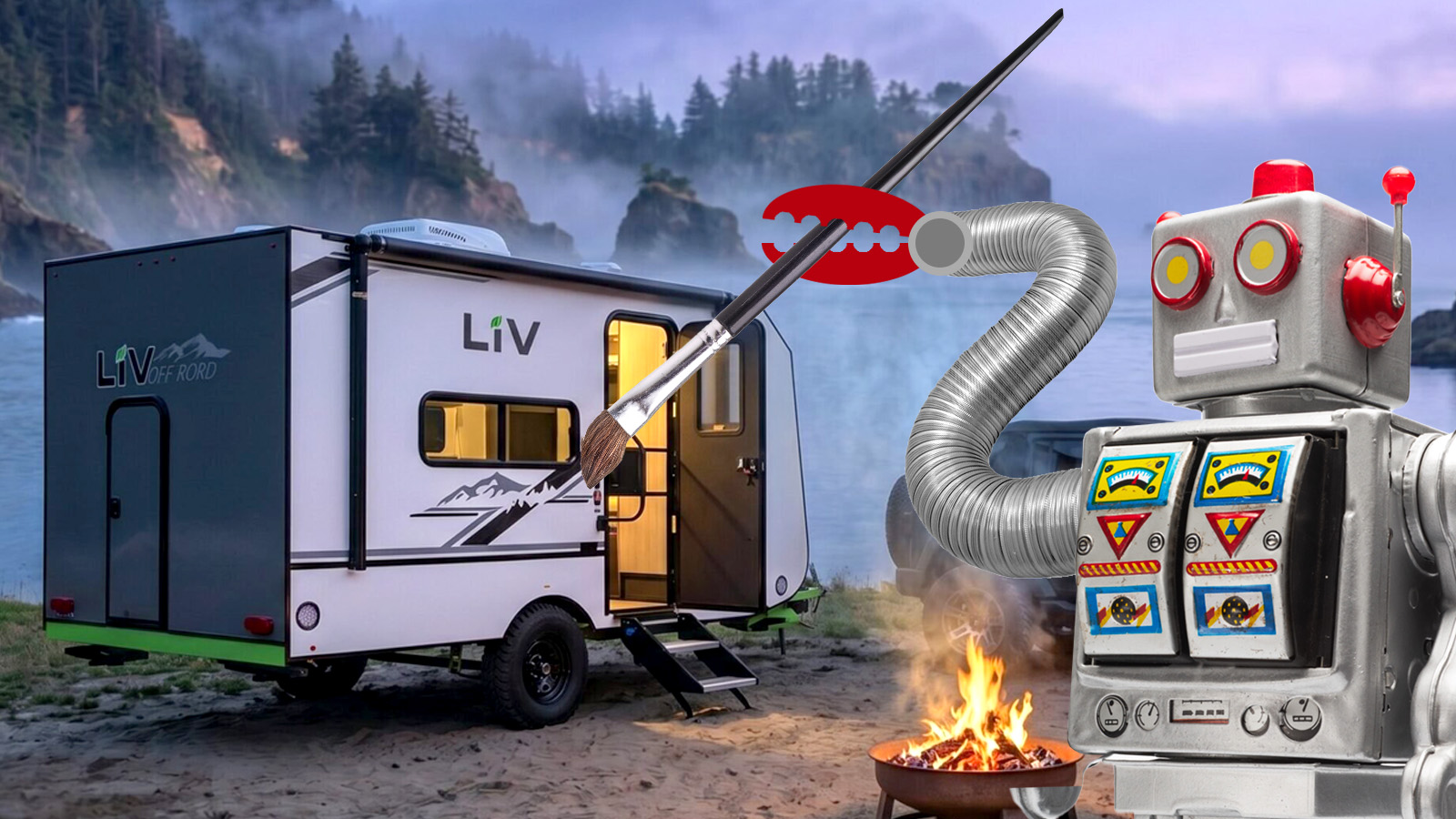
This AI image shows a parking lot reflected in the windows, no tire tracks, and it clearly didn’t know what to do with the background of the open side door. Also, I love how the AI couldn’t even get the name right, and “VIV” is on the side of the trailer.
This AI image couldn’t even spell the trailer’s model correctly:
Enhance! “Off Rord” is equal parts sad and hilarious:
The filenames for all of these images contain “gemini” in them, and the Gemini watermark is present in most of them, so LIV didn’t even try to remove the evidence.
This is all so deeply disappointing. I get that LIV’s old images (an example is below) weren’t exciting, but I’d rather have boring real images than “exciting” fake ones. I just end up going back to wondering why the company couldn’t be bothered to tow their own RVs out to a campground for real pictures.
Getting live pictures of an RV isn’t hard. Just tow it to your local forest preserve, snap some pictures with your phone, and that’s good enough. Or, since you’re an RV manufacturer, maybe just go to a campground and sleep in your own unit for a night.
This would be like if Ford didn’t bother actually taking the Mustang GTD to a track, and instead just had AI generate a fake track.
I also recently wrote about the Search4 Outdoors S4 Trailer. Image sourcing on this one was a total disaster because I couldn’t tell what was real. Supposedly, this image was taken at the Bahia Honda State Park in Florida:
But then there’s this image, showing the same trailer in the same parking spot, but the outdoor grille is gone, with surfers in its place. The second surfboard looks like a shark bit off its back. I can’t even trust that the original image wasn’t AI, and on close inspection, it probably is AI.
Even inTech, another brand that I have given lots of praise to in the past, couldn’t resist the call of AI. The company just launched an all-new travel trailer, and the hero shot, the image everyone is going to see when they land on the product page, is more AI:
The frustrating part is that the person who told AI to generate this image never even bothered to make sure the AI didn’t butcher the company’s name. Well, it did!
To the credit of the big companies, I haven’t seen much obvious AI from the likes of Thor Industries, Winnebago, or Forest River. Many RV manufacturers within these mega conglomerates will use composite photos. These are often a real picture of an RV combined with a separate, but also real picture of scenery. For example, here’s a Forest River tent trailer:
While it looks really weird, I’m more okay with it because at least I know the trailer in the image is real. Some companies will also do a digital image like this, which is also fine, I think:
In fact, Airstream, Thor’s flagship brand, is perhaps the absolute best RV company in the industry when it comes to photography, documentation, and history. Airstream goes through the work to actually haul its trailers out to scenic areas to have professional photos taken of them. The company also maintains an archive of documentation of historic models, and its blog has so many great pictures of old Airstreams. I wish all RV companies put in even just half the effort of Airstream.
So far as I can tell, the use of gen-AI imagery in the RV world is more recent and is, at least for now, seemingly limited to independent brands. On one hand, I get it; small RV companies don’t really have the resources of Thor Industries or Forest River. It’s easier to get an AI to cough out an image than spend valuable time hauling a trailer out to the wilderness. However, lots of small, independent RV companies still do take real pictures, like Scamp, Ember, or Bigfoot RV.
I also want to note that AI imagery doesn’t mean that the company makes bad trailers. I still believe in LIV’s thermoplastics and inTech’s futuristic-looking aluminum builds. But from the view of potential customers, AI imagery can look lazy. An RV might be the second-largest purchase a person makes, or maybe even the largest, if that person lives in their RV. The whole point of an RV is to take you on an adventure. It’s disappointing to see when a manufacturer doesn’t put in the effort to even depict an adventure. There are good uses for AI as a concept, like taking notes or biomedical research, but faking a road trip through gen-AI isn’t one of them.
So, if you’re one of these RV companies and you’re reading this, know that I’m not trying to bash you. I just think you’re doing yourself and your customers a disservice by not using real images of your products. I mean, just on a basic level, it’s a bad look if your company’s name isn’t even spelled correctly in your own imagery.
But maybe I’m off-base here. RV influencers already use tons of generative AI, and there do seem to be a lot of people who either don’t care about AI or even actively support it. So, perhaps I’m a young-ish woman yelling at a cloud here.
I do know that, at the very least, if I catch an RV manufacturer using AI, you can count on me not using said images in my posts. I want to show people what they’re actually going to get, not something fed through a slop machine. So, if you see me using dealership images when talking about a new RV release, AI is probably why. With some hope, maybe this trend won’t expand any further.
Top graphic images: International RV; DepositPhotos.com