NASCIO 2026 State CIO Survey: Finding a Path to AI Maturity - GovTech
High confidence: full text extraction produced 4807 characters.
That was the theme of the annual survey of state CIOs from the National Association of State CIOs (NASCIO), released Monday: Change. Just as many seem to have plotted a path forward on AI, they are faced with a wave of gubernatorial elections that promise to shake up leadership, coinciding with new political pressures.
THE PATH TO AI MATURITY
That path would involve, at baseline, enterprise policies and procedures on AI development and use, which 98 percent of respondents said they have in place. Beyond that, a significant majority of states have guidance or rules in place regarding ethics, safety or responsible use. Most also have advisory committees or task forces in place, as well as governance frameworks, use case inventories and special procurement requirements. An emerging and growing practice is requiring vendors to disclose their use of AI.
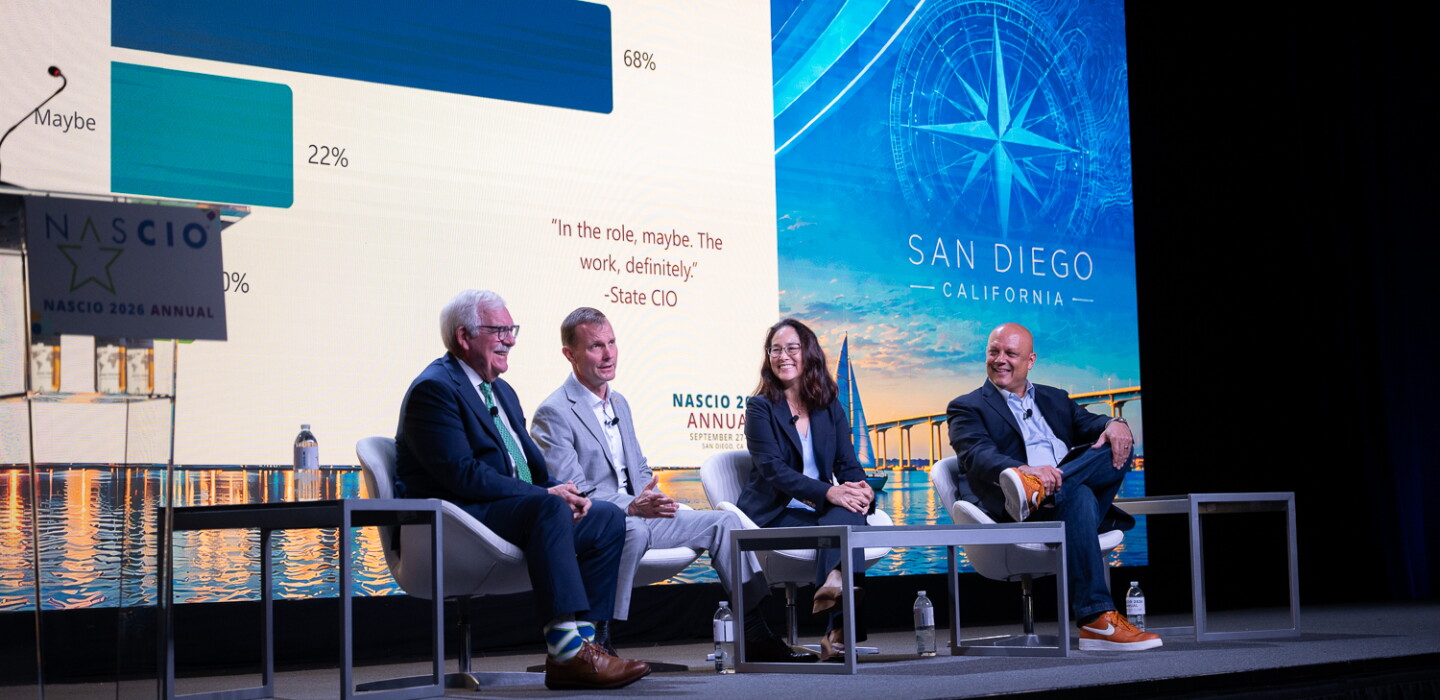
Warren Sponholtz, CIO for the state of Florida, said during the NASCIO Annual Conference that activities educating government employees on AI are critical.
In Texas, the state has actually required state agencies and local governments to adopt an AI code of ethics. Tony Sauerhoff, the state’s CIO, said that common ground is important for the future of the technology.
“The driver of that is public trust,“ he said. “We can’t afford to lose that.”
About half the states have at least one employee with “AI” in their title.
The survey also charted, for the first time, just how many states have reached the level of enterprisewide AI projects in the executive branch: 35 percent, or about 18 states. Nearly every respondent had pilot projects and proof-of-concept efforts in place, while 82 percent had projects in the production phase.
Those findings are in step with the results of the Center for Digital Government’s* 2026 Digital States Survey, which found that 53 percent of states had implemented AI and 38 percent were conducting pilots or proofs-of-concept. That survey also found that 24 percent of states were rolling out enterprisewide AI tools.
Widespread agreement has emerged that agentic AI — AI which can perform actions on its own, as distinct from generative AI which is focused on creation — will be the most impactful technology in the next two to three years. Almost 30 percent of respondents said they were using agentic AI, while 35 percent said they have plans to, and about 30 percent said they had no plans.
“I think the agentic AI revolution has the potential to dramatically transform government,” an anonymous CIO said in the survey. “We have spent decades building software systems with a user interface that assumes the user is a human. What happens when that is an AI agent? The process of business fundamentally needs to change.”
A TIME OF CHANGE
With the midterm elections, 36 states will hold governors’ races; of those, 18 are guaranteed a new governor. Naturally, many states will have new CIOs in 2027.
But there are other reasons for change to the role of the CIO and the state IT department. A major one is funding: state budgets are more constrained this year than they have been recently, and new concerns are mounting about cybersecurity, AI and other topics.
According to the survey, several states are revisiting the long-standing chargeback model where agencies are charged directly for the IT department’s services.
A major concern here is stability. Especially when it comes to fluctuating or mounting concerns about cybersecurity, AI, innovation work, accessibility and more, most states lack dedicated funding streams. According to the report, some are considering hybrid models with “enterprise-funded” shared services and direct billing for special services. Some are thinking about dedicated funds for specific areas — Minnesota, for example, has a new modernization fund for human services systems.
Critical infrastructure cybersecurity has become a significant threat, with 88 percent of CIOs rating it as a “high concern.” A wave of cyber attacks on water utilities this year has shown why.
“If your concerns are not significant, you need to pay more attention,” one CIO said.
CIOs are also increasingly finding themselves pulled into political matters, or else finding IT decisions cast in political lighting. Notably, that includes hyperscale data centers to support AI, which have drawn bipartisan opposition as concerns have cropped up about power costs, water consumption and more.
About half of CIOs said they had a role in that debate or expected to, ranging from serving on task forces to advising governors or legislators and providing technical expertise.
“The CIO role is to provide balanced, practical guidance that considers economic opportunity, environmental stewardship, infrastructure readiness, cybersecurity and the long-term technology needs of the state,” one CIO said.