Optimizing the delivery of radiotherapy with artificial intelligence - nature.com
High confidence: full text extraction produced 36472 characters.
Abstract
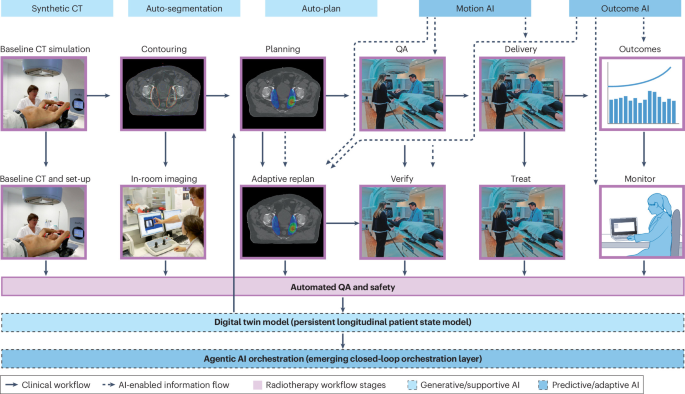
Artificial intelligence (AI) and machine learning are transformative technologies that have sparked both excitement and concern. In radiation oncology, AI has been successfully applied to automate tasks, such as auto-contouring, geometric adaptation, calculation of radiation dose and quality assurance, and predicting outcomes to provide optimal patient care. The clinical deployment of AI-driven and machine learning-based tools, however, continues to lag behind their perceived potentials, owing to a range of technical, practical, ethical and legal concerns. The original predictive AI algorithms have been expanded with technologies such as generative AI and foundation models to enable new applications, such as automated treatment planning and synthetic computed tomography generation, as well as improved prediction of individual patient outcomes. The increasing availability of innovations such as agentic AI, digital twins and multimodal AI could further improve the delivery and, thus, the efficacy of radiotherapy. In this Review, we present examples of successful AI applications in radiation oncology, provide an overview of the current challenges for implementing such tools in this specialty and strategies for addressing them, and discuss the broader implications of these tools in optimizing treatment outcomes and the quality of patient care.
Key Points
-
Artificial intelligence (AI) is currently transforming radiation oncology workflows and patient care through a growing number of commercially available and Food and Drug Administration-approved tools.
-
AI is transforming the defined roles of radiation oncology care providers by automating routine tasks and supporting predictive and clinical decision-making, while expert human oversight remains essential across AI-enabled workflows.
-
Many ongoing clinical trials are evaluating the technical performance and feasibility of AI-enabled applications for radiation oncology, and clinical research is now starting to address the safety, efficacy and clinical value of these tools.
-
Despite substantial progress, several challenges hinder the effective implementation of AI tools into routine radiation oncology workflows, and the field needs practical recommendations to support responsible clinical adoption of these tools.
-
The convergence of digital twins, generative AI and foundation models is poised to shape the next era of AI-enabled radiotherapy.
Access options
Access Nature and 54 other Nature Portfolio journals
Get Nature+, our best-value online-access subscription
27,99 € / 30 days
cancel any time
Subscribe to this journal
Receive 12 print issues and online access
189,00 € per year
only 15,75 € per issue
Buy this article
39,95 €
Prices may be subject to local taxes which are calculated during checkout
References
- Halperin, E. C., Wazer, D. E., Blitzblau, R. C., Esiashvili, N. & Baumann, B. Perez, Brady, Halperin, and Wazer’s Principles and Practice of Radiation Oncology 8th edn (Wolters Kluwer, 2025).
- Huynh, E. et al. Artificial intelligence in radiation oncology. Nat. Rev. Clin. Oncol. 17, 771–781 (2020).
- Landry, G., Kurz, C. & Traverso, A. The role of artificial intelligence in radiotherapy clinical practice. BJR Open. 5, 20230030 (2023).
- Li, G., Wu, X. & Ma, X. Artificial intelligence in radiotherapy. Semin. Cancer Biol. 86, 160–171 (2022).
- El Naqa, I. & Murphy, M. J. Machine and Deep Learning in Oncology, Medical Physics and Radiology (Springer, 2022).
- Willoughby, T. R., Starkschall, G., Janjan, N. A. & Rosen, I. I. Evaluation and scoring of radiotherapy treatment plans using an artificial neural network. Int. J. Radiat. Oncol. Biol. Phys. 34, 923–930 (1996).
- Rowbottom, C. G., Webb, S. & Oldham, M. Beam-orientation customization using an artificial neural network. Phys. Med. Biol. 44, 2251–2262 (1999).
- Wells, D. M. & Niederer, J. A medical expert system approach using artificial neural networks for standardized treatment planning. Int. J. Radiat. Oncol. Biol. Phys. 41, 173–182 (1998).
- El Naqa, I. et al. Multivariable modeling of radiotherapy outcomes, including dose–volume and clinical factors. Int. J. Radiat. Oncol. Biol. Phys. 64, 1275–1286 https://doi.org/10.1016/j.ijrobp.2005.11.022 (2006).
- El Naqa, I., Bradley, J. D., Lindsay, P. E., Hope, A. J. & Deasy, J. O. Predicting radiotherapy outcomes using statistical learning techniques. Phys. Med. Biol. 54, S9–S30 (2009).
- Gulliford, S. L., Webb, S., Rowbottom, C. G., Corne, D. W. & Dearnaley, D. P. Use of artificial neural networks to predict biological outcomes for patients receiving radical radiotherapy of the prostate. Radiother. Oncol. 71, 3–12 (2004).
- Munley, M. T. et al. A neural network to predict symptomatic lung injury. Phys. Med. Biol. 44, 2241–2249 (1999).
- Su, M. et al. An artificial neural network for predicting the incidence of radiation pneumonitis. Med. Phys. 32, 318–325 (2005).
- Ibragimov, B. & Xing, L. Segmentation of organs-at-risks in head and neck CT images using convolutional neural networks. Med. Phys. 44, 547–557 (2017).
- Nikolov, S. et al. Clinically applicable segmentation of head and heck anatomy for radiotherapy: deep learning algorithm development and validation study. J. Med. Internet Res. 23, e26151 https://doi.org/10.2196/26151 (2021).
- Nguyen, D. et al. A feasibility study for predicting optimal radiation therapy dose distributions of prostate cancer patients from patient anatomy using deep learning. Sci. Rep. 9, 1076 https://doi.org/10.1038/s41598-018-37741-x (2019).
- Nguyen, D. et al. 3D radiotherapy dose prediction on head and neck cancer patients with a hierarchically densely connected U-net deep learning architecture. Phys. Med. Biol. 64, 065020 https://doi.org/10.1088/1361-6560/ab039b (2019).
- Nguyen, D. et al. Three-dimensional radiotherapy dose prediction on head and neck cancer patients with a hierarchically densely connected U-net deep learning architecture. Phys. Med. Biol. https://doi.org/10.1088/1361-6560/ab039b (2018).
- Shen, C. et al. Intelligent inverse treatment planning via deep reinforcement learning, a proof-of-principle study in high dose-rate brachytherapy for cervical cancer. Phys. Med. Biol. 64, 115013 https://doi.org/10.1088/1361-6560/ab18bf (2019).
- Avanzo, M. et al. Machine and deep learning methods for radiomics. Med. Phys. 47, e185–e202 https://doi.org/10.1002/mp.13678 (2020).
- Coates, J. T. T., Pirovano, G. & El Naqa, I. Radiomic and radiogenomic modeling for radiotherapy: strategies, pitfalls, and challenges. J. Med. Imaging 8, 031902 (2021).
- Tseng, H. H., Luo, Y., Ten Haken, R. K. & El Naqa, I. The role of machine learning in knowledge-based response-adapted radiotherapy. Front. Oncol. 8, 266 (2018).
- Tarhini, A. A., Dave, P. & El Naqa, I. General artificial intelligence for the diagnosis and treatment of cancer: the rise of foundation models. BJR Artif Intell. 2, ubaf015 https://doi.org/10.1093/bjrai/ubaf015 (2025).
- Qi, X. S. et al. Generative AI, foundation models and large language models in radiation therapy physics: clinical applications, challenges, and future directions. Med. Phys. 53, e70616 https://doi.org/10.1002/mp.70616 (2026).
- Deist, T. M. et al. Machine learning algorithms for outcome prediction in (chemo)radiotherapy: an empirical comparison of classifiers. Med. Phys. 45, 3449–3459 (2018).
- Duke, K. & Papanikolaou, N. Artificial intelligence in radiation therapy: from imaging to delivery—a comprehensive review. BJR Artif. Intell. 2, ubaf012 (2025).
- The National Academies Collection: Reports funded by National Institutes of Health, Foundational Research Gaps and Future Directions for Digital Twins (National Academy of Sciences, 2024).
- Zhang, N. Digital Twins and Intelligence: A Symbiotic Framework. PhD thesis, Univ. Birmingham (2023).
- Gu, Z., Liu, F., Chen, J., Yin, C. & Zhang, P. A proactive agent collaborative framework for zero-shot multimodal medical reasoning. Adv. Intell. Syst. 7, 2400840 (2025).
- Srinivasu, P. N., Aruna Kumari, G. L., Ahmed, S. & Alhumam, A. Exploring agentic AI in healthcare: a study on its working mechanism. Front. Med. 12, 1753443 (2025).
- Wang, Q. et al. A feasibility study of automating radiotherapy planning with large language model agents. Phys. Med. Biol. https://doi.org/10.1088/1361-6560/adbff1 (2025).
- Hassoon, A. et al. Randomized trial of two artificial intelligence coaching interventions to increase physical activity in cancer survivors. NPJ Digit. Med. 4, 168 (2021).
- Chaudhuri, A. et al. Predictive digital twin for optimizing patient-specific radiotherapy regimens under uncertainty in high-grade gliomas. Front. Artif. Intell. 6, 1222612 (2023).
- Giansanti, D. & Morelli, S. Exploring the potential of digital twins in cancer treatment: a narrative review of reviews. J. Clin. Med. 14, 3574 (2025).
- Chang, C. W. et al. Exploration of an adaptive proton therapy strategy using CBCT with the concept of digital twins. Phys. Med. Biol. https://doi.org/10.1088/1361-6560/ada684 (2025).
- Katsoulakis, E. et al. Digital twins for health: a scoping review. NPJ Digit. Med. 7, 77 (2024).
- Laubenbacher, R., Mehrad, B., Shmulevich, I. & Trayanova, N. Digital twins in medicine. Nat. Comput. Sci. 4, 184–191 (2024).
- Mackay, K., Bernstein, D., Glocker, B., Kamnitsas, K. & Taylor, A. A review of the metrics used to assess auto-contouring systems in radiotherapy. Clin. Oncol. 35, 354–369 https://doi.org/10.1016/j.clon.2023.01.016 (2023).
- Han, Z. et al. Artificial intelligence-assisted delineation for postoperative radiotherapy in patients with lung cancer: a prospective, multi-center, cohort study. Front. Oncol. 14, 1388297 https://doi.org/10.3389/fonc.2024.1388297 (2024).
- Rasmussen, M. E. et al. Potential of E-learning interventions and artificial intelligence-assisted contouring skills in radiotherapy: the ELAISA study. JCO Glob. Oncol. 10, e2400173 https://doi.org/10.1200/GO.24.00173 (2024).
- Rhee, D. J. et al. Automated radiation treatment planning for cervical cancer. Semin. Radiat. Oncol. 30, 340–347 https://doi.org/10.1016/j.semradonc.2020.05.006 (2020).
- Asher, G. L. et al. Dosimetric evaluations using cycle-consistent generative adversarial network synthetic CT for MR-guided adaptive radiation therapy. Front. Oncol. 15, 1672778 https://doi.org/10.3389/fonc.2025.1672778 (2025).
- Truhn, D., Eckardt, J. N., Ferber, D. & Kather, J. N. Large language models and multimodal foundation models for precision oncology. NPJ Precis. Oncol. 8, 72 https://doi.org/10.1038/s41698-024-00573-2 (2024).
- Jensen, J. & Deng, J. Digital twins for radiation oncology. In Companion Proc. of the ACM Web Conf. 2023, 989–993 (Association for Computing Machinery, 2023).
- Mastroleo, F. et al. Translational barriers to digital twins in radiation oncology. Phys. Imaging Radiat. Oncol. 40, 101024 https://doi.org/10.1016/j.phro.2026.101024 (2026).
- Thangaraj, P. M., Benson, S. H., Oikonomou, E. K., Asselbergs, F. W. & Khera, R. Cardiovascular care with digital twin technology in the era of generative artificial intelligence. Eur. Heart J. 45, 4808–4821 https://doi.org/10.1093/eurheartj/ehae619 (2024).
- Rahmim, A. et al. Theranostic digital twins for personalized radiopharmaceutical therapies: reimagining theranostics via computational nuclear oncology. Front. Oncol. 12, 1062592 https://doi.org/10.3389/fonc.2022.1062592 (2022).
- Strigari, L. et al. Computational nuclear oncology toward precision radiopharmaceutical therapies: ethical, regulatory, and socioeconomic dimensions of theranostic digital twins. J. Nucl. Med. 66, 748–756 https://doi.org/10.2967/jnumed.124.268186 (2025).
- McNaughton, J. et al. Machine learning for medical image translation: a systematic review. Bioengineering https://doi.org/10.3390/bioengineering10091078 (2023).
- Boulanger, M. et al. Deep learning methods to generate synthetic CT from MRI in radiotherapy: a literature review. Phys. Med. 89, 265–281 https://doi.org/10.1016/j.ejmp.2021.07.027 (2021).
- Xiao, F. et al. Deep learning-based synthetic-CT-free photon dose calculation in MR-guided radiotherapy: a proof-of-concept study. Med. Phys. 52, e70106 https://doi.org/10.1002/mp.70106 (2025).
- Bahloul, M. A. et al. Advancements in synthetic CT generation from MRI: a review of techniques, and trends in radiation therapy planning. J. Appl. Clin. Med. Phys. 25, e14499 (2024).
- O’Connor, L. M. et al. Comparison of synthetic computed tomography generation methods, incorporating male and female anatomical differences, for magnetic resonance imaging-only definitive pelvic radiotherapy. Front. Oncol. 12, 822687 https://doi.org/10.3389/fonc.2022.822687 (2022).
- Emami, H., Dong, M., Nejad-Davarani, S. P. & Glide-Hurst, C. K. Generating synthetic CTs from magnetic resonance images using generative adversarial networks. Med. Phys. https://doi.org/10.1002/mp.13047 (2018).
- Han, X. MR-based synthetic CT generation using a deep convolutional neural network method. Med. Phys. 44, 1408–1419 https://doi.org/10.1002/mp.12155 (2017).
- Koul, A., Duran, D. & Hernandez-Boussard, T. Synthetic data, synthetic trust: navigating data challenges in the digital revolution. Lancet Digit. Health 7, 100924 https://doi.org/10.1016/j.landig.2025.100924 (2025).
- Meyer, C. et al. Artificial intelligence contouring in radiotherapy for organs-at-risk and lymph node areas. Radiat. Oncol. 19, 168 https://doi.org/10.1186/s13014-024-02554-y (2024).
- Darby, P. et al. Inter-observer variability in radiotherapy contouring with the use of autocontouring software: a systematic review. Clin. Transl. Radiat. Oncol. 58, 101144 https://doi.org/10.1016/j.ctro.2026.101144 (2026).
- Lucido, J. J. et al. Validation of clinical acceptability of deep-learning-based automated segmentation of organs-at-risk for head-and-neck radiotherapy treatment planning. Front. Oncol. 13, 1137803 https://doi.org/10.3389/fonc.2023.1137803 (2023).
- Doolan, P. J. et al. A clinical evaluation of the performance of five commercial artificial intelligence contouring systems for radiotherapy. Front. Oncol. 13, 1213068 (2023).
- Bitterman, D. S. et al. A randomized controlled crossover trial to evaluate the efficacy of AI-assisted heart contouring. Int. J. Radiat. Oncol. Biol. Physics 120, S41 https://doi.org/10.1016/j.ijrobp.2024.07.061 (2024).
- Appenzoller, L. M., Michalski, J. M., Thorstad, W. L., Mutic, S. & Moore, K. L. Predicting dose–volume histograms for organs-at-risk in IMRT planning. Med. Phys. 39, 7446–7461 (2012).
- Chung, C. V. et al. Knowledge-based planning for fully automated radiation therapy treatment planning of 10 different cancer sites. Radiother. Oncol. 202, 110609 (2025).
- Shen, C., Chen, L. & Jia, X. A hierarchical deep reinforcement learning framework for intelligent automatic treatment planning of prostate cancer intensity modulated radiation therapy. Phys. Med. Biol. https://doi.org/10.1088/1361-6560/ac09a2 (2021).
- Yang, D. et al. Automated treatment planning with deep reinforcement learning for head-and-neck (HN) cancer intensity modulated radiation therapy (IMRT). Phys. Med. Biol. https://doi.org/10.1088/1361-6560/ad965d (2024).
- Giraud, P. & Bibault, J. E. Artificial intelligence in radiotherapy: current applications and future trends. Diagn. Interv. Imaging 105, 475–480 (2024).
- Portik, D. et al. Knowledge-based versus deep learning based treatment planning for breast radiotherapy. Phys. Imaging Radiat. Oncol. 29, 100539 https://doi.org/10.1016/j.phro.2024.100539 (2024).
- Parikh, P. J. et al. A multi-institutional phase 2 trial of ablative 5-fraction stereotactic magnetic resonance-guided on-table adaptive radiation therapy for borderline resectable and locally advanced pancreatic cancer. Int. J. Radiat. Oncol. Biol. Phys. 117, 799–808 (2023).
- Leeman, J. E. et al. Magnetic resonance-guided prostate stereotactic body radiation therapy with daily online plan adaptation: results of a prospective phase 1 trial and supplemental cohort. Adv. Radiat. Oncol. 7, 100934 https://doi.org/10.1016/j.adro.2022.100934 (2022).
- Yoganathan, S. A., Maria Das, K. J., Agarwal, A. & Kumar, S. Magnitude, impact, and management of respiration-induced target motion in radiotherapy treatment: a comprehensive review. J. Med. Phys. 42, 101–115 https://doi.org/10.4103/jmp.JMP_22_17 (2017).
- Yuan, X. et al. Machine learning in image-based outcome prediction after radiotherapy: a review. J. Appl. Clin. Med. Phys. 26, e14559 https://doi.org/10.1002/acm2.14559 (2025).
- Mastroleo, F. et al. Large language models for toxicity extraction in oncology trials: a real-world benchmark in prostate radiotherapy. Radiother. Oncol. 216, 111348 (2026).
- Dudas, D., Dilling, T. J., Jim, H. & Naqa, I. E. Effective use of PROs for survival prediction: Transformer-based modelling in NSCLC patients. Radiother. Oncol. 218, 111441 https://doi.org/10.1016/j.radonc.2026.111441 (2026).
- Reuter, L. M. et al. Prediction of symptomatic radiation pneumonitis in lung cancer patients: a radiomics and dosiomics machine learning approach using the prospective multicenter RTOG 0617 and REQUITE trials. Int. J. Radiat. Oncol. Biol. Phys. 125, 1149–1159 https://doi.org/10.1016/j.ijrobp.2026.01.031 (2026).
- Men, K. et al. A deep learning model for predicting xerostomia due to radiation therapy for head and neck squamous cell carcinoma in the RTOG 0522 clinical trial. Int. J. Radiat. Oncol. Biol. Phys. 105, 440–447 https://doi.org/10.1016/j.ijrobp.2019.06.009 (2019).
- Dehelean, D. C. et al. Evaluating large language models as an educational tool for meningioma patients: patient and clinician perspectives. Radiat. Oncol. 20, 101 (2025).
- Olson, K. D. et al. Use of ambient AI scribes to reduce administrative burden and professional burnout. JAMA Netw. Open 8, e2534976 https://doi.org/10.1001/jamanetworkopen.2025.34976 (2025).
- Duggan, M. J. et al. Clinician experiences with ambient scribe technology to assist with documentation burden and efficiency. JAMA Netw. Open. 8, e2460637 https://doi.org/10.1001/jamanetworkopen.2024.60637 (2025).
- Shah, S. J. et al. Physician perspectives on ambient AI scribes. JAMA Netw. Open. 8, e251904 (2025).
- Lee, P., Bubeck, S. & Petro, J. Benefits, limits, and risks of GPT-4 as an AI chatbot for medicine. N. Engl. J. Med. 388, 1233–1239 (2023).
- Vitriol, J. A., O’Shea, B. A. & Calanchini, J. Less biased yet more defensive: the impact of control processes. J. Exp. Psychol. Appl. 30, 108–119 (2024).
- Claessens, M. et al. Quality assurance for AI-based applications in radiation therapy. Semin. Radiat. Oncol. 32, 421–431 (2022).
- Huang, Y. et al. Deep learning for patient-specific quality assurance: predicting gamma passing rates for IMRT based on delivery fluence informed by log files. Technol. Cancer Res. Treat. 21, 15330338221104881 https://doi.org/10.1177/15330338221104881 (2022).
- Miao, J., Xu, Y., Men, K. & Dai, J. A feasibility study of deep learning prediction model for VMAT patient-specific QA. Front. Oncol. 15, 1509449 https://doi.org/10.3389/fonc.2025.1509449 (2025).
- Nyflot, M. J., Thammasorn, P., Wootton, L. S., Ford, E. C. & Chaovalitwongse, W. A. Deep learning for patient-specific quality assurance: identifying errors in radiotherapy delivery by radiomic analysis of gamma images with convolutional neural networks. Med. Phys. 46, 456–464 https://doi.org/10.1002/mp.13338 (2019).
- Luk, S. M. H., Ford, E. C., Phillips, M. H. & Kalet, A. M. Improving the quality of care in radiation oncology using artificial intelligence. Clin. Oncol. 34, 89–98 (2022).
- Ono, T. et al. Applications of artificial intelligence for machine- and patient-specific quality assurance in radiation therapy: current status and future directions. J. Radiat. Res. 65, 421–432 (2024).
- El Naqa, I. A Guide To Outcome Modeling in Radiotherapy and Oncology: Listening to the Data (CRC Press, 2018).
- Cui, S. et al. Artificial intelligence for outcome modeling in radiotherapy. Semin. Radiat. Oncol. 32, 351–364 (2022).
- Wang, S., Wang, K. & Lin, J. Predictive value of machine learning for radiation pneumonitis and checkpoint inhibitor pneumonitis in lung cancer patients: a systematic review and meta-analysis. Sci. Rep. 15, 20961 https://doi.org/10.1038/s41598-025-05505-z (2025).
- Cui, S., Ten Haken, R. K. & El Naqa, I. Integrating multiomics information in deep learning architectures for joint actuarial outcome prediction in non-small cell lung cancer patients after radiation therapy. Int. J. Radiat. Oncol. Biol. Phys. 110, 893–904 (2021).
- El Naqa, I. et al. Translation of AI into oncology clinical practice. Oncogene 42, 3089–3097 (2023).
- Kelly, C. J., Karthikesalingam, A., Suleyman, M., Corrado, G. & King, D. Key challenges for delivering clinical impact with artificial intelligence. BMC Med. 17, 195 (2019).
- Allen, L. N. et al. Artificial intelligence in primary care: frameworks, challenges, and guardrails. Lancet Prim. Care 2, 100079 (2025).
- Wang, F. & Beecy, A. Implementing AI models in clinical workflows: a roadmap. BMJ Evid. Based Med. 30, 285–287 (2025).
- El Naqa, I., Moran, J. & Ten Haken, R. in The Modern Technology of Radiation Oncology. A Compendium for Medical Physicists and Radiation Oncologists vol. 4 (ed. Van Dyk, J.) 301–320 (Medical Physics Pub, 2020).
- Hurkmans, C. et al. A joint ESTRO and AAPM guideline for development, clinical validation and reporting of artificial intelligence models in radiation therapy. Radiother. Oncol. 197, 110345 (2024).
- Pillai, M. et al. Using artificial intelligence to improve the quality and safety of radiation therapy. J. Am. Coll. Radiol. 16, 1267–1272 (2019).
- Vandewinckele, L. et al. Overview of artificial intelligence-based applications in radiotherapy: recommendations for implementation and quality assurance. Radiother. Oncol. 153, 55–66 (2020).
- Food and Drug Administration. Artificial Intelligence & Medical Products: How CBER, CDER, CDRH, and OCP are Working Together (US FDA, 2024).
- Xu, J., Zhou, L., Chen, P., Qiu, W. & Liu, M. Whole lifecycle evolution control method of modular product structure oriented to personalized service. Int. J. Comput. Integr. Manuf. 34, 1108–1124 https://doi.org/10.1080/0951192X.2021.1963480 (2021).
- European Union. The EU Artificial Intelligence Act (EU, 2024).
- El Kababji, S. et al. Augmenting insufficiently accruing oncology clinical trials using generative models: validation study. J. Med. Internet Res. 27, e66821 (2025).
- Sumini, M., Teodori, F. & Isolan, L. Digital twins in dosimetry and radiotherapy, a survey and some applications. Radiat. Phys. Chem. 218, 111649 (2024).
- Chang, C. W. et al. A digital twin framework for adaptive treatment planning in radiotherapy. Phys. Med. Biol. https://doi.org/10.1088/1361-6560/ae835a (2026).
- Olawade, D. B. et al. Digital twin applications in radiology and radiotherapy: applications, challenges, and future perspectives. Eur. J. Radiol. 200, 112865 https://doi.org/10.1016/j.ejrad.2026.112865 (2026).
- Elhaminia, B. et al. Deep learning combining imaging, dose and clinical data for predicting bowel toxicity after pelvic radiotherapy. Phys. Imaging Radiat. Oncol. 33, 100710 https://doi.org/10.1016/j.phro.2025.100710 (2025).
- Jing, B. et al. Multimodal prediction for radiotherapy-induced hematologic toxicity in rectal cancer patients. NPJ Precis. Oncol. https://doi.org/10.1038/s41698-026-01476-0 (2026).
- Fuhrman, J. D. et al. A review of explainable and interpretable AI with applications in COVID-19 imaging. Med. Phys. 49, 1–14 https://doi.org/10.1002/mp.15359 (2022).
- Drabiak, K., Kyzer, S., Nemov, V. & El Naqa, I. AI and machine learning ethics, law, diversity, and global impact. Br. J. Radiol. 96, 20220934 https://doi.org/10.1259/bjr.20220934 (2023).
- Luo, Y. et al. A human-in-the-loop based Bayesian network approach to improve imbalanced radiation outcomes prediction for hepatocellular cancer patients with stereotactic body radiotherapy. Front. Oncol. 12, 1061024 https://doi.org/10.3389/fonc.2022.1061024 (2022).
- Gooding, M. J., Boukerroui, D., Vasquez Osorio, E., Monshouwer, R. & Brunenberg, E. Multicenter comparison of measures for quantitative evaluation of contouring in radiotherapy. Phys. Imaging Radiat. Oncol. 24, 152–158 https://doi.org/10.1016/j.phro.2022.11.009 (2022).
- Mayo, C. S. et al. Operational ontology for oncology (O3): a professional society-based, multistakeholder, consensus-driven informatics standard supporting clinical and research use of real-world data from patients treated for cancer. Int. J. Radiat. Oncol. Biol. Phys. 117, 533–550 https://doi.org/10.1016/j.ijrobp.2023.05.033 (2023).
- Zhang, J., Lei, Y., Xia, J., Chao, M. & Liu, T. Federated learning for enhanced dose–volume parameter prediction with decentralized data. Med. Phys. 52, 1408–1415 https://doi.org/10.1002/mp.17566 (2025).
- Shah, K. D. et al. Linear federated learning for outcome prediction with application to hepatocellular carcinoma radiotherapy. JCO Clin. Cancer Inf. 9, e2500074 https://doi.org/10.1200/CCI-25-00074 (2025).
- Jochems, A. et al. Developing and validating a survival prediction model for NSCLC patients through distributed learning across 3 countries. Int. J. Radiat. Oncol. Biol. Phys. 99, 344–352 https://doi.org/10.1016/j.ijrobp.2017.04.021 (2017).
- Bibault, J. E. & Giraud, P. Deep learning for automated segmentation in radiotherapy: a narrative review. Br. J. Radiol. 97, 13–20 https://doi.org/10.1093/bjr/tqad018 (2024).
- Rattay, T. et al. External validation of a predictive model for acute skin radiation toxicity in the REQUITE breast cohort. Front. Oncol. 10, 575909 https://doi.org/10.3389/fonc.2020.575909 (2020).
- Buchner, J. A. et al. Development and external validation of an MRI-based neural network for brain metastasis segmentation in the AURORA multicenter study. Radiother. Oncol. 178, 109425 https://doi.org/10.1016/j.radonc.2022.11.014 (2023).
- Marketing submission recommendations for a predetermined change control plan for artificial intelligence-enabled device software functions. FDA https://www.fda.gov/regulatory-information/search-fda-guidance-documents/marketing-submission-recommendations-predetermined-change-control-plan-artificial-intelligence (2025).
- Good machine learning practice for medical device development: guiding principles. FDA https://www.fda.gov/medical-devices/software-medical-device-samd/good-machine-learning-practice-medical-device-development-guiding-principles (2025).
- Stetson, P. D. et al. Responsible artificial intelligence governance in oncology. NPJ Digit. Med. 8, 407 (2025).
- Kang, J. et al. National cancer institute workshop on artificial intelligence in radiation oncology: training the next generation. Pract. Radiat. Oncol. 11, 74–83 https://doi.org/10.1016/j.prro.2020.06.001 (2021).
- Kwon, Y. S. et al. Artificial intelligence-empowered radiation oncology residency education. Pract. Radiat. Oncol. 13, 8–10 https://doi.org/10.1016/j.prro.2022.09.003 (2023).
- Decoster, R. et al. Towards an accessible, centralised, searchable database for AI courses in Europe: the artificial intelligence in medical imaging and radiation oncology education (AIMIROE) project. Eur. Radiol. Exp. https://doi.org/10.1186/s41747-026-00745-8 (2026).
- Lerner, M. et al. Clinical validation of a commercially available deep learning software for synthetic CT generation for brain. Radiat. Oncol. 16, 66 https://doi.org/10.1186/s13014-021-01794-6 (2021).
- Yamauchi, R. et al. Clinical evaluation of deep learning and atlas-based auto-segmentation for organs at risk delineation. Med. Dosim. 49, 167–176 https://doi.org/10.1016/j.meddos.2023.11.002 (2024).
- Maduro Bustos, L. A. et al. Feasibility evaluation of novel AI-based deep-learning contouring algorithm for radiotherapy. J. Appl. Clin. Med. Phys. 24, e14090 https://doi.org/10.1002/acm2.14090 (2023).
- Byrne, M. et al. Varian ethos online adaptive radiotherapy for prostate cancer: early results of contouring accuracy, treatment plan quality, and treatment time. J. Appl. Clin. Med. Phys. 23, e13479 https://doi.org/10.1002/acm2.13479 (2022).
- Fusco, R. et al. Quantitative imaging decision support (QIDS(TM)) tool consistency evaluation and radiomic analysis by means of 594 metrics in lung carcinoma on chest CT scan. Cancer Control 28, 1073274820985786 https://doi.org/10.1177/1073274820985786 (2021).
- Ryczkowski, A., Jodda, A. & Piotrowski, T. Linking RayStation AI auto-contouring with eclipse TPS: a scripted workflow for clinical integration. Rep. Pract. Oncol. Radiother. 30, 749–757 https://doi.org/10.5603/rpor.109182 (2025).
- Caissie, A. et al. Head and neck radiation therapy patterns of practice variability identified as a challenge to real-world big data: results from the learning from analysis of multicentre big data aggregation (LAMBDA) consortium. Adv. Radiat. Oncol. 8, 100925 https://doi.org/10.1016/j.adro.2022.100925 (2023).
- Yahya, N. et al. Independent external validation of predictive models for urinary dysfunction following external beam radiotherapy of the prostate: issues in model development and reporting. Radiother. Oncol. 120, 339–345 https://doi.org/10.1016/j.radonc.2016.05.010 (2016).
- Pang, E. P. P. et al. Multicentre evaluation of deep learning CT autosegmentation of the head and neck region for radiotherapy. npj Digit. Med. 8, 312 https://doi.org/10.1038/s41746-025-01624-z (2025).
- Rusanov, B. et al. Guidance on selecting and evaluating AI auto-segmentation systems in clinical radiotherapy: insights from a six-vendor analysis. Phys. Engineer. Sci. Med. 48, 301–316 https://doi.org/10.1007/s13246-024-01513-x (2025).
- Vaassen, F. et al. Evaluation of measures for assessing time-saving of automatic organ-at-risk segmentation in radiotherapy. Phys. Imaging Radiat. Oncol. 13, 1–6 https://doi.org/10.1016/j.phro.2019.12.001 (2020).
- Cross, J. L., Choma, M. A. & Onofrey, J. A. Bias in medical AI: implications for clinical decision-making. PLoS Digit. Health 3, e0000651 https://doi.org/10.1371/journal.pdig.0000651 (2024).
- McQuinlan, Y. et al. An investigation into the risk of population bias in deep learning autocontouring. Radiother. Oncol. 186, 109747 https://doi.org/10.1016/j.radonc.2023.109747 (2023).
- Weissman, G. E. Evaluation and regulation of artificial intelligence medical devices for clinical decision support. Annu. Rev. Biomed. Data Sci. 8, 81–99 https://doi.org/10.1146/annurev-biodatasci-103123-095824 (2025).
- Guberina, N. et al. Do AI-based contouring algorithms influence physicians in the online adaptive radiotherapy of patients with bladder cancer? Tech. Innov. Patient Support Radiat. Oncol. 38, 100401 https://doi.org/10.1016/j.tipsro.2026.100401 (2026).
- Nealon, K. A. et al. Using failure mode and effects analysis to evaluate risk in the clinical adoption of automated contouring and treatment planning tools. Pract. Radiat. Oncol. 12, e344–e353 (2022).
Acknowledgements
The work of E.K. and I.E.N. has been partly supported by the National Institute of Health (NIH; grant R01-CA233487) and US Department of Defense (DOD; grant W81XWH-22-1-0276).
Author information
Authors and Affiliations
Contributions
All authors contributed to researching data for the article and contributed substantially to discussion of the contents. E.K. wrote the article. All authors reviewed and/or edited the manuscript before submission.
Corresponding author
Ethics declarations
Competing interests
E.K. owns stocks in Abbvie, Bristol-Myers Squibb and Pfizer, and is one of the founding members of Digital Twin for Health. I.E.N. acts as co-Editor-in-Chief of BJR Artificial Intelligence and deputy editor of Medical Physics, and is a co-founder of iRAI Technologies.
Peer review
Peer review information
Nature Reviews Clinical Oncology thanks Coen Hurkmans, who co-reviewed with Eva Beek; Daniela Thorwarth, who co-reviewed with Natalie West; and the other, anonymous, reviewer(s) for their contribution to the peer review of this work.
Additional information
Publisher’s note Springer Nature remains neutral with regard to jurisdictional claims in published maps and institutional affiliations.
Glossary
- Agentic AI
-
AI systems composed of multiple agents that are orchestrated autonomously or semi-autonomously to execute complex tasks by breaking them down into smaller interdependent steps carried out by these agents.
- Automation bias
-
The tendency for users to over-rely on recommendations or outputs generated by automated systems, potentially overlooking contradictory clinical information or errors.
- Continuous learning
-
The process of periodically or continuously updating an AI model using newly available data to maintain or improve performance as clinical practices, patient populations or data distributions evolve.
- Data leakage
-
The inadvertent use of information from the validation or test data during model training, resulting in overly optimistic estimates of model performance and reduced generalizability to new data.
- Deep learning
-
Subfield of machine learning that uses neural networks to learn directly from raw data.
- Explainable AI
-
AI methods that make model outputs understandable to humans, supporting transparency and trust in decision-making.
- Fine-tuning strategies
-
In the context of AI, process of adapting a pretrained model to a specific task or dataset through additional training on domain-specific data.
- Foundation model
-
Large-scale model trained on broad, diverse datasets that can be adapted to a wide range of downstream tasks (such as segmentation, planning or outcome prediction) with minimal task-specific training.
- Generative AI
-
Models that can generate novel content (text, images, code, audio and so on) by learning patterns from large datasets.
- Hallucination
-
In the context of AI, this term refers to a model generating incorrect or fabricated outputs that are not grounded in the input data or in reality.
- Large language model
-
(LLM). A type of generative AI trained on very large text corpora using self-supervised learning that can understand and generate human-like language.
- Machine learning
-
Subfield of AI that uses computer algorithms that can learn from previous experiences without being explicitly programmed for every rule.
- Multimodal AI
-
AI model that integrates and processes multiple data types (such as imaging, text, genomics and clinical data) to generate unified predictions that, in radiation oncology, might be relevant to agentic orchestration and adaptive workflows.
- Reinforcement learning
-
Machine learning paradigm in which models ‘learn’ to make decisions by optimizing actions on the basis of feedback from an environment.
- Silent model failure
-
Deterioration or failure in AI model performance that occurs without an obvious warning to the user, potentially resulting from factors such as data or distribution shift.
- Uncertainty estimation
-
Methods used to quantify the confidence of model predictions, often used to flag low-confidence outputs requiring human review.
- Vision–language model
-
(VLM). A type of generative AI (multimodal foundation models) trained on very large multimodal data (such as text, images or videos corpora) that can generate visual data in response to such inputs.
Rights and permissions
Springer Nature or its licensor (e.g. a society or other partner) holds exclusive rights to this article under a publishing agreement with the author(s) or other rightsholder(s); author self-archiving of the accepted manuscript version of this article is solely governed by the terms of such publishing agreement and applicable law.
About this article
Cite this article
Katsoulakis, E., El Naqa, I. Optimizing the delivery of radiotherapy with artificial intelligence. Nat Rev Clin Oncol (2026). https://doi.org/10.1038/s41571-026-01204-4
- Accepted:
- Published:
- Version of record:
- DOI: https://doi.org/10.1038/s41571-026-01204-4