SSE Dean Talks Human-Centered AI, Innovation, Governance at SLU-Madrid : SLU - Saint Louis University
High confidence: full text extraction produced 2917 characters.
SSE Dean Talks Human-Centered AI, Innovation, Governance at SLU-Madrid
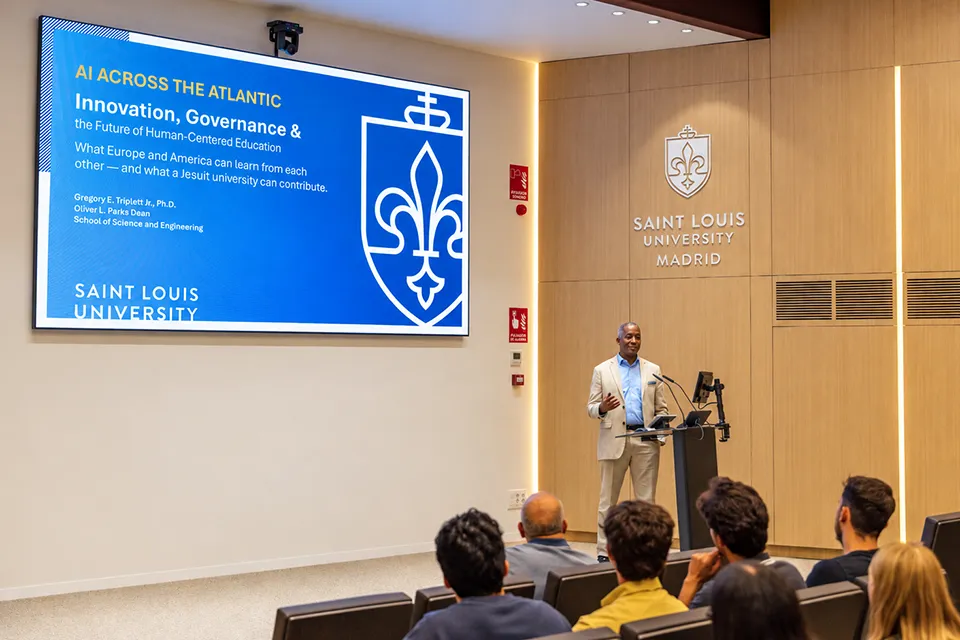
Saint Louis University-Madrid welcomed Gregory Triplett, Ph.D., Oliver L. Parks Dean of the School of Science and Engineering, on Sept. 21 for a conversation about artificial intelligence, responsible innovation, and the role of universities in shaping a human-centered future.
Triplett's talk, "AI Across the Atlantic: Innovation, Governance & the Future of Human-Centered Education: What Europe and America Can Learn from Each Other — and What a Jesuit University Can Contribute," examined different approaches to artificial intelligence on both sides of the Atlantic and what higher education can learn from them.
During his talk, Triplett contrasted what he described as two different instincts. In the United States, the emphasis has often been on experimentation, scale and innovation. In Europe, the emerging approach places greater attention on risk, transparency, fundamental rights and accountability.
Rather than seeing those approaches as incompatible, Triplett suggested that universities can help bring them together.
"The choice is not innovation or governance. The challenge is designing institutions capable of both," Triplett said.
For SLU-Madrid, that conversation matters especially. As an American university operating in a European regulatory environment and serving a highly international student body, the Madrid campus sits at the intersection of the two approaches.
Triplett also challenged universities to think beyond the technical skills involved in using artificial intelligence. He argued that AI literacy requires people to understand what the technology can and cannot do, question issues such as accuracy and bias, recognize when human judgment must remain decisive, and use AI responsibly and transparently.
He presented a Jesuit framework built around three questions: Can I use AI effectively? Should I trust or use this output? Am I prepared to own the consequences?
"Our goal is not simply graduates who know how to use AI, but graduates who know when to use it, when to question it, and when not to use it," Triplett said.
The discussion also explored how oversight should change depending on how AI is used. Brainstorming or generating ideas may carry relatively limited consequences, while uses related to assessment, admissions or academic progression raise more significant questions of fairness, access and accountability.
At the center of the presentation was the idea that innovation should not come at the expense of the human dimensions of education: judgment, relationships, responsibility and purpose.
Triplett described a possible 'third way' for Jesuit higher education, one that combines bold experimentation with responsible governance while keeping human agency at the center.
He closed the talk with a question for the audience: "What kind of human beings do we want AI to help us become?"