Microsoft Tracks AI Adoption Rates, U.S. Ranking Stalls 09/22/2026 - MediaPost
High confidence: full text extraction produced 4005 characters.
Microsoft has studied the speed and
adoption rates of artificial intelligence (AI) technology worldwide, rather than simply tracking how much revenue AI companies make.
Shifting the metric from how much money AI companies make
to how many people use AI daily reveals the scale of new advertising placements being created as the technology matures.
It also identifies real-world market penetration that determines the
next generation of infrastructure required for digital advertising and a further shift to automated media buying, optimization and other features.
The report 00 titled Global AI Diffusion Q2
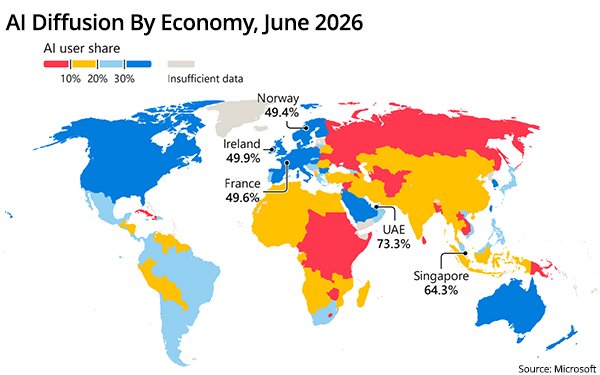
2026 Trends and Insights and published Monday through the Microsoft AI Economy Institute -- tracks how generative AI is spreading across 147 economies and shows where adoption is growing most
rapidly.
The ranking for the United Stated did not change from quarter to quarter this year. The U.S. ranked No. 21 in first-quarter 2026 and remained the same in second-quarter 2026.
advertisement
advertisement
The U.S. grew 1.7 percentage points -- from 31.3% in the first quarter of 2026 to 33% in the second quarter of 2026.
AI use continued to climb in the second quarter of 2026 globally. In
June, AI use rose about 1% to 18.8% for the working-age population worldwide, compared with the first quarter of this year. Nearly every world economy experienced an increase.
New data
released today highlights how the dynamics between the Global North and Global South have shifted over the last quarter.
The Global North leans toward consumer use such as shopping, search,
and feedback. The Global South focuses on learning with elements including image, text, and code creation and editing.
Together, these results suggest that educational support may be
particularly important to AI in regions that are early adopters. This is consistent with recent studies of Bing Copilot, Gemini and Claude, which also find schooling or coursework to be a larger part
of observed AI use in lower-income countries.
In the report, Microsoft cautioned that interpretation of the findings for the North and the South only applies to early adopters using AI in
these regions and may not follow this path as AI use expands to broader populations.
Notably, in the second quarter of 2026, the United Arab Emirates and Singapore continued to top the
leaderboard at 73.3% and 64.3%, respectively.
South Korea saw the largest absolute change -- rising 3.5 percentage points -- with Saudi Arabia climbing five places to No. 25 from No. 30.
Microsoft noted that this was the largest increase in rank.
Japan recorded the largest relative change -- increasing 2.2 percentage points in the second quarter of 2026, or roughly 10%
relative to its Q1 usage of 22.5%.
Worldwide, the second quarter brought continued broadening of the AI gap between the global North and global South, with use now at 28.8% in the North and
16.2% in the South.
Tracking these trends required Microsoft to measure AI expansion worldwide as the share of people between the ages of 15 and 64 who have used a generative AI product during
the first or second quarters in 2026.
Microsoft calculated the numbers using anonymous data from the company’s branded devices, and then adjusted them to accurately match each country's
population, internet access, and the types of computers people use.
In terms of the economy, countries leading the AI push include the United Arab Emirates at 73.3% and Singapore at 64.3%,
followed by Ireland at 49.9% and France at 49.6%.
Within the top 25, South Korea again gained 3.5 percentage points -- the largest quarterly increase in the group. It climbed four places to
rank No. 12, up from No 14.
South Korea posted the largest gain of any major economy for three consecutive reporting periods from the first half in 2025 to Q1 2026 to Q2 2026 -- adding nearly
15 points to its AI user share during the past 12 months.
Saudi Arabia saw the largest increase in ranking, entering the top twenty-five at No. 25, up from No. 30.