California Ads Must Disclose When Actors Are AI-Generated Under New Law - Law Commentary
High confidence: full text extraction produced 5998 characters.
California will bar social media platforms from offering addictive features such as infinite scroll and autoplay to users under 16, impose new safeguards on AI companion chatbots and expose some companies to damages reaching $1 million per child under a sweeping package signed Thursday by Gov. Gavin Newsom.Signed September 10,... Read More »
California Ads Must Disclose When Actors Are AI-Generated Under New Law
California will require advertisers to tell consumers when a realistic actor selling a product or service was generated by artificial intelligence under a new law signed Wednesday by Gov. Gavin Newsom.
Senate Bill 1050 requires a clear and conspicuous disclosure when an audio, video or audiovisual advertisement prominently features an AI-generated “synthetic performer.” The new California AI advertising law is set to take effect Jan. 1, 2027.
“Californians deserve to know when the person selling them something isn’t a person at all,” Newsom said in announcing the signing.
The law targets realistic AI actors who can demonstrate products, narrate commercials or deliver sales pitches while appearing to viewers as human performers. It places the disclosure requirement within California’s false advertising laws, opening advertisers to enforcement when a covered commercial runs without the required notice.
SB 1050 defines a synthetic performer as a digital figure, voice or representation created in whole or in part with generative AI that gives the realistic impression of a human performance without representing an identifiable real person.
The disclosure must be difficult to miss and understandable to a reasonable consumer. The legislation offers examples including “this performance features a synthetic performer” and “no human performer is depicted.”
The requirement applies when the AI performer has a prominent role in the commercial. That can include appearing in the foreground to demonstrate a product or service, delivering an on-camera or off-camera sales message, or reacting to an advertisement’s narration or pitch.
The law also gives courts a way to stop an unlawful AI-generated ad from continuing to circulate. After a court finds a violation, streaming services, online platforms, broadcasters, publishers and other advertising outlets that receive the order and enough information to identify the commercial must stop distributing it in California as soon as commercially reasonable and technically feasible.
Those outlets must also stop accepting payment to continue running the ad.
The provision extends the law beyond the company that created or paid for a commercial, although duties for platforms and other distributors begin only after a court has found a violation.
SB 1050 focuses on artificial performers who do not represent identifiable real people. California already has separate protections governing digital replicas of actual actors and other recognizable individuals, including rules addressing the use of performers’ voices and likenesses.
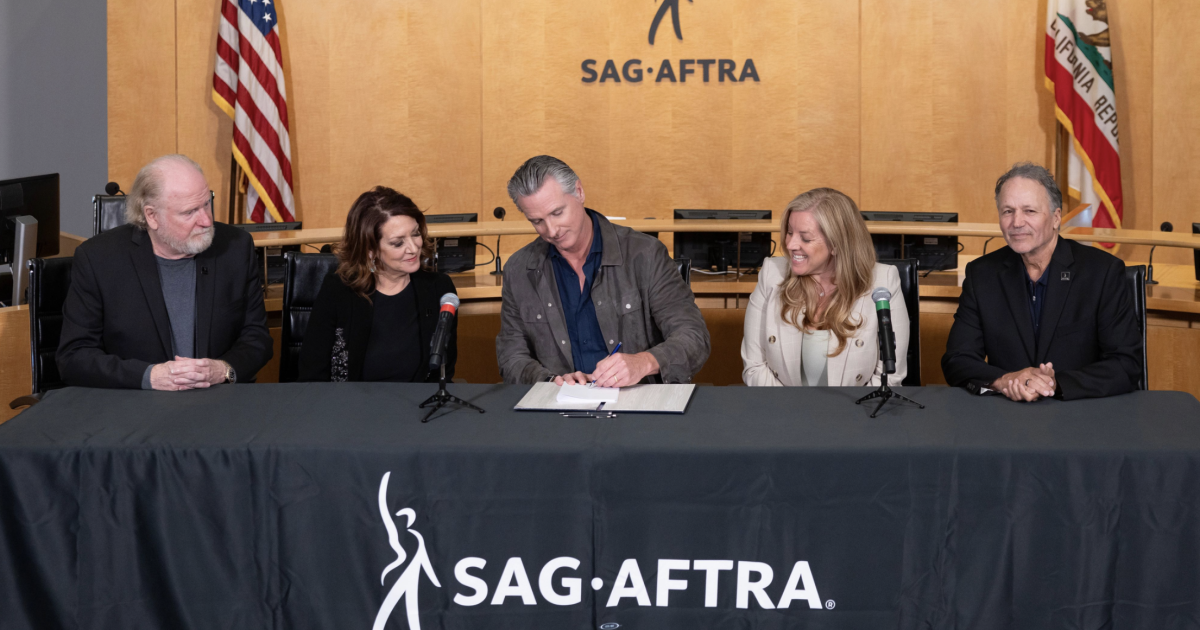
Newsom signed the legislation at SAG-AFTRA’s Los Angeles headquarters alongside state Sen. Angelique Ashby, who authored the bill. SAG-AFTRA sponsored the measure as performers and other entertainment workers have pushed for protections against the expanding commercial use of generative AI.
SAG-AFTRA National Executive Director Duncan Crabtree-Ireland said the law would give consumers greater transparency about whether they are watching a human performer while addressing the use of AI in place of human creative work.
Several uses of generative AI are exempt. The disclosure mandate does not cover AI used solely to translate a human performer or provide certain accessibility features. Promotions for movies, television programs, streaming content, documentaries, video games and similar works can also qualify for an exemption when the synthetic performer appears consistently with the underlying production.
Business and technology groups raised concerns as the bill moved through Sacramento, including objections to its definitions, disclosure requirements and enforcement structure. Lawmakers narrowed parts of the proposal before passage, including limiting the mandate to synthetic performers featured prominently in an advertisement.
California follows New York, which began requiring disclosures for synthetic performers in advertising earlier this year. SB 1050 adds advertising to California’s growing set of rules governing AI-generated media, digital likenesses and the use of artificial intelligence in entertainment.
Related Articles
Artificial intelligence can add a fireplace to a real estate listing photo, erase damaged flooring or make a room look larger in seconds. As those alterations become harder to detect, states are beginning to set new rules for how brokers, agents and sellers can use them.California already requires real estate... Read More »
New York prosecutors have taken down 12 websites accused of selling AI-generated pornography depicting about 1,200 real people without their consent, including actors, politicians, athletes, musicians and social media figures.Manhattan District Attorney Alvin Bragg announced the September 14 action after his office obtained a court order authorizing the seizure of... Read More »
California lawmakers have approved legislation that would impose new requirements on attorneys who use generative artificial intelligence, including verifying AI-generated work, disclosing its use in court filings, and protecting confidential client information.Senate Bill 574, known as the Court A.I. Protection Act, passed the Legislature and was sent to Gov. Gavin... Read More »
AI-generated nude and sexual deepfakes can now lead to criminal charges under federal law and in a growing number of states, as lawmakers move to punish realistic sexual images created or shared without a person's consent.The rules remain a patchwork. Federal law largely targets publication, while states including Florida, Texas... Read More »