Artificial Feminist Intelligence Is Not Feminism - Ms. Magazine
High confidence: full text extraction produced 10783 characters.
From reproductive health chatbots to elder-care robots, the AI industry’s promise of empathy obscures the workers it exploits and the care systems it is helping replace.
Despite the fact that AI seems to be everywhere these days, a surprising recent poll from NBC News shows AI is even less popular among the U.S. public than ICE. So it is no wonder the same industry that is developing AI for corporate gain and warfare is pushing into more seemingly benevolent territory: reproductive health, elder care, education, therapy, emotional support and intimacy.
For decades, the familiar figure of a white male chess prodigy personified the fantasy of intelligence in computing. From Cold War game theory, to IBM’s Deep Blue defeating Garry Kasparov in 1997, technologists measured machine intelligence against an ideal of abstract, disembodied and overwhelmingly masculinized strategic mastery. To be intelligent meant calculating more accurately and efficiently, predicting and anticipating opponents’ moves, and above all, winning.
This fantasy still endures today, as we see in the race for artificial general intelligence (AGI)—the as-yet-unrealized goal (shared by tech firms and states alike) of building AI systems that match or surpass human intelligence, as measured through skills like writing essays, passing the bar exam or coding.
But alongside these familiar masculine frames for intelligence, softer figurations of AI have recently begun to crowd the market. From an always-listening pendant sold as a “wearable mom,” to an elder-care companion robot that would take the place of a grandchild, AI is increasingly being sold in feminized, familial terms as companionable, empathetic, human-centered and even caring.
I call these new care and emotional support AI models “artificial feminist intelligence,” or AFI. If AGI promises machines that can think like (or better than) humans, AFI promises machines that can care for us. It is an adjunct AI that increasingly commodifies the “soft skills” associated with the traditionally feminized sphere that scholars Eileen Boris and Racal Salazar Parreñas have termed “intimate labors.”
AFI is decidedly not a feminist future for AI. It appropriates supposedly feminine forms of intelligence while bypassing feminism’s actual demands: labor rights, reproductive justice, racial justice, freedom from violence, economic redistribution, demilitarization and accountability. It distracts us from the harder work of building feminist futures.
There are grave consequences if we fall under the spell of AI’s “AURA,” Kalindi Vora and Neda Atanasoski’s acronym for “Aesthetic, Ubiquitous, Regimented Automation,” which makes the automation of intimacy feel magical by wrapping extraction and control into an appealing package that can be sold as doing good.
In April, Fortune reported that the emergency contraception brand Julie had launched an “emotionally intelligent” AI chatbot to answer questions about the morning-after pill, fertility and basic sex education. These are questions that many users are already taking to TikTok, Reddit and other social media spaces, as well other chatbots like ChatGPT.
It is easy to see the draw for the more than 50,000 women visiting the Julie site every month. In a country where sexual health education has been decimated, abortion access is increasingly restricted, and shame is still an obstacle to reproductive care for minors, such technologies are filling in gaps in the available resources. Femtech, the data-driven tech sector targeting women’s health, was estimated to have a U.S. market value of $28.46 billion in 2025, with a projected reach of $114.95 billion by 2035.
At the same time, it is crucial not to mistake femtech access for reproductive justice. Even when these tools are free to users, they often operate within data-driven business models that turn intimate health questions into extractable value. We must interrogate the ownership of these emerging platforms and the nature of the data being harvested. When reproductive health inquiries are integrated into for-profit economic ecosystems, what are the implications? In a political landscape where bodily autonomy is increasingly criminalized and surveilled, is it possible to design a chatbot that safeguards users’ privacy?
Artificial feminist intelligence moves into the gaps left by crumbling social safety nets and institutions. Its appeal can obscure the deeper crisis: the disappearance of accessible, affordable and medically reliable reproductive healthcare.
… Although women make up 47 percent of U.S. workers, they account for 83 percent of workers in AI-vulnerable occupations.
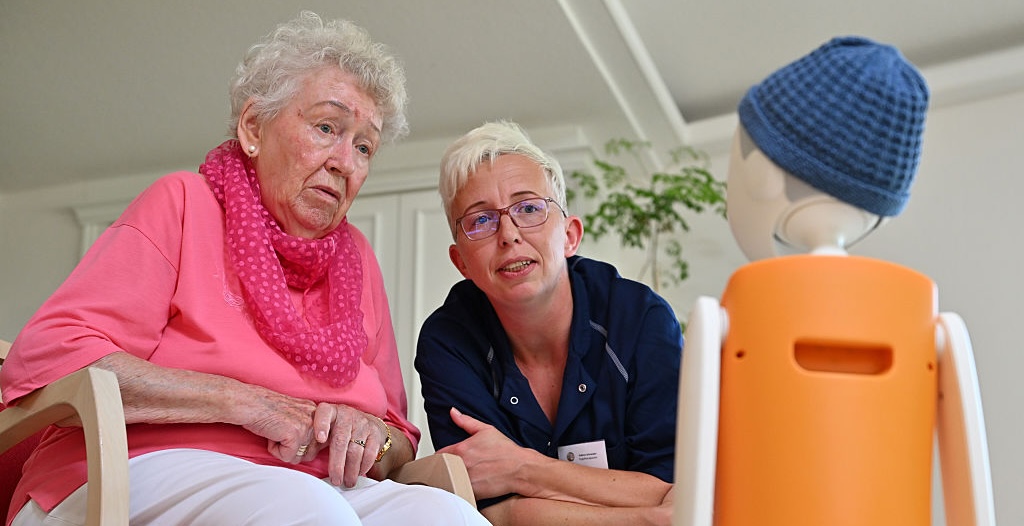
Elder care is at a similar crisis point in the U.S. The Washington Post recently profiled Abi, an AI-powered robot companion being rolled out to senior care facilities in the United States after launching in Australia. Billed as “bringing empathy to care homes,” Abi can lead activities, speak multiple languages, remember personal details and offer one-on-one companionship.
The market need for this robot seems clear: Loneliness is a devastating problem among older adults. Care workers (28 percent of whom are immigrants) are overburdened, families are stretched and institutions are understaffed.
Meanwhile, by 2026, elder-care technologies, including AI companion robots, remote monitoring and home-health platforms, represent a market worth tens of billions of dollars globally, with narrower categories such as elder-care robots valued at $4 billion, and broader AI-in-aging markets estimated at above $50 billion.
Asking whether a robot can make an older person smile sidesteps the more fundamental feminist question: Is technology supplementing a robust care system, or providing a lucrative cover for its abandonment? The recent firing of hospital nurses deemed “redundant” because of AI suggests the latter is already happening.
The same question can be asked of AI companions more broadly. Psychologists are tracking how chatbots and digital companions are reshaping emotional connection, with attendant risks of dependency and isolation for frequent users. These systems are often marketed as endlessly patient, nonjudgmental, and available, even as they prey on those most vulnerable because they are designed to validate and please. In other words, they simulate the feminized labor of listening, soothing, remembering and affirming. They automate the historically gendered expectation that a wife, servant or mistress should remain endlessly available without expecting anything in return.
Almost none of the caring and compassionate AI models deal with gendered labor issues.
A 2026 National Partnership for Women and Families analysis found that although women make up 47 percent of U.S. workers, they account for 83 percent of workers in AI-vulnerable occupations.
In May, 12 nurses were fired and replaced by AI at Montefiore Hospital in the Bronx.
Women of color account for 31 percent of workers in the 15 most AI-vulnerable jobs.
These figures point to ongoing precarity of feminized and racialized laborers that has always been part of the US economy. They also raise vital questions. Who owns these platforms? Whose labor trained them? Whose vulnerabilities make them profitable? Whose bodies become the testing grounds for their failures? And why, in the midst of a care crisis, are we being forced to buy into systems selling artificial intimacy?
AI’s fantasy of care feeds on colonized and underpaid workers tasked with scrubbing violence, pornography and hate speech from AI models. OpenAI contracted with Sama, an outsourcing vendor, to employ data labelers in Kenya who earned between $1.32 and $2.00 an hour. These workers read and filtered traumatic and toxic content to help train ChatGPT to respond more safely. In turn, they suffered from PTSD, depression and anxiety brought on by the content they encountered.
Meanwhile, in April the MIT Technology Review reported that “People in Nigeria and India are strapping iPhones onto their heads and recording themselves doing chores” like vacuuming, washing dishes, cooking and folding laundry to send training data to robotics companies. This hidden labor force makes the machine appear attentive and nurturing while reproducing the racialized and feminized exploitation on which its intelligence depends.
Supporters of AI in care domains will argue, not wrongly, that these tools can expand access. A chatbot may answer a question a teenager is afraid to ask. A companion robot may ease an older person’s isolation. An AI assistant may help an overworked caregiver. These possibilities should not be dismissed. Yet a privatized substitute for care is not the same as a care infrastructure. A reproductive health chatbot is not reproductive justice. A companion robot is not elder justice. An empathetic assistant or robot that helps with domestic chores does not protect underpaid data workers in the Global South.
Artificial feminist intelligence is not feminism. Rather, feminism is the refusal of a future in which care itself becomes another site of extraction.
*
A note from Ms. editors: We want to hear from you for The Majority, a new campaign collecting stories about how reproductive freedom has enabled readers to build the lives they want and need. Poll after poll shows a majority of Americans support reproductive healthcare access. Yet public debate overlooks the lives shaped by abortion access, contraception, IVF, miscarriage care, maternal healthcare or comprehensive sex education—countless women who chose to pursue an education, have children, not have children, protect their health and chart their own future. Add your voice and complete the sentence: “Access to reproductive choices gave me the freedom to….” Together, these stories will help show not only why reproductive freedom remains a majority value, but also what it makes possible.
Look to these trusted groups if you or a loved one needs to know more about reliable abortion care:
- A one-stop-shop for abortion seekers: I Need An A
- Other websites to explore all your options for abortion care: Plan C Pills, Abortion Finder
- Safe websites to buy abortion medication: Aid Access, Massachusetts Medication Abortion Access Project, Hey Jane
- If you need help affording abortion care, tell your telemedicine provider or contact an abortion fund near you.
- To protect your digital privacy when planning your abortion, click here.
- For free legal help as a patient or doctor, call If/When/How’s Repro Helpline—844-868-2812—or contact Pregnancy Justice.
- For medical advice, contact the Miscarriage & Abortion Hotline: 833-246-2632.
- If you need to know the abortion law in your state, look to the Center for Reproductive Rights. or Guttmacher Institute.