U.Va. Health expands AI use across patient care, research and education - The Cavalier Daily
High confidence: full text extraction produced 6799 characters.
Health systems nationwide have begun implementing a growing array of artificial intelligence tools across clinical care, administrative operations and research. The pace and scope of AI adoption has varied across regions of the United States, with some states moving more aggressively than others.
In Utah, for example, health systems are piloting programs that allow AI to autonomously process prescription refills for medications used to treat chronic conditions such as hypertension and hyperlipidemia to help alleviate clinician burden. Utah faces a large physician shortage.
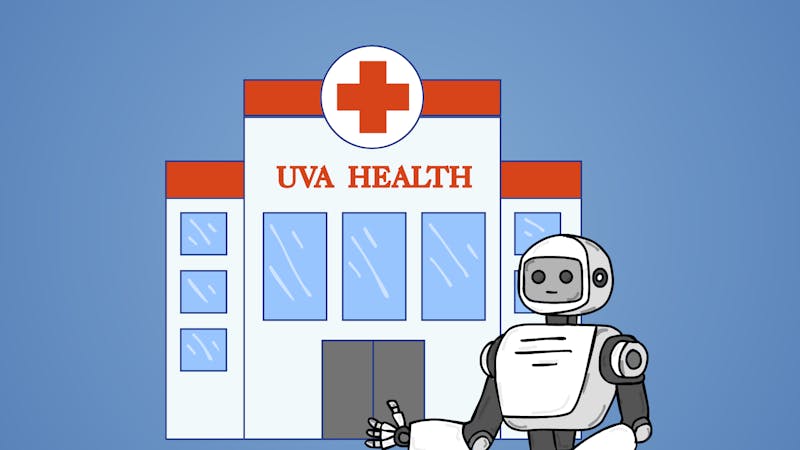
According to Eric Swensen, U.Va. Heath’s public information officer, U.Va. Health has begun utilizing AI tools in “carefully defined, low-risk ways” across the system in three distinct areas — patient care and operations, research and education.
Within patient care and operations, AI tools are beginning to assist clinicians with documentation which allows them to spend more time with patients, according to Swensen. He also said that the technology is being used for operational functions. Swensen explained that AI is helping optimize hospital bed utilization, improve patient flow — the movement of patients from the point of admission to a healthcare facility to discharge — and align staffing resources.
Swensen said that research at U.Va. Health has started to apply tools to areas such as treatment optimization, cancer research, medical imaging analysis and drug discovery. He also said that the system is looking at how AI tools can enhance medical education and clinical training for the School of Medicine and the School of Nursing.
According to Dr. Arwen Declan, adjunct faculty at Clemson University and Dr. Andrew Taylor, professor of emergency medicine at the University — who together developed a framework for responsible AI implementation in healthcare — one of the most commonly used AI tools at present is ambient dictation.
Ambient dictation utilizes AI to listen to encounters between clinicians and their patients to assist in clinical documentation such as encounter note taking, physical exam findings and medical decision-making thought processes. DAX Copilot is an example of one such ambient dictation tool, and is the tool that U.Va. Health currently utilizes and offers to their providers.
Declan said that ambient dictation has helped improve the patient experience because it has allowed clinicians to be more present in conversation with their patients without feeling the need to personally document information during the encounter. She also said that beyond these tools being useful for improving patient care, the data and recordings they collect can be valuable in research.
Declan added that the way in which health systems choose to implement AI tools is what will shape whether they are used to benefit the patient experience or not.
“If you put an AI system in and you focus on having your clinicians see more patients more quickly, then that says what you want is throughput,” Declan said. “If you put an AI system in and you say, ‘Okay, I'm not going to cut clinician time,’ then you actually open space for the physician to focus on the patient.”
Outside of U.Va. Health, other health systems in Virginia have also begun to implement AI and machine learning tools to benefit patient care and improve health outcomes.
For example, Southwest Virginia based health system Carilion Clinic implemented an AI prediction model in May 2022 to predict when patients might develop sepsis six hours prior to when they actually become septic based on available clinical data within their health record. The model and other efforts by the system has helped to decrease sepsis mortality by 18 percent across the system, according to the Carilion Clinic Analytics Hub.
Carilion Clinic also implemented a second AI predictive analysis model to identify a patient’s risk of being readmitted to the hospital by utilizing key risk factors in the medical record. The model and other efforts by the system has helped to decrease readmissions by 22 percent.
To help address the growing utilization of AI in healthcare, Declan and Taylor have created a “framework” for AI tool implementation — the Total Mission Value framework — to ensure AI implementation is done ethically in healthcare.
Their framework is aimed at moving beyond merely evaluating AI tools by how much they cost to utilize, and combines the importance of understanding their economic impact while remaining focused on how they affect education and patient care. The values of their framework are built on five priorities — patient care, staff experience, hospital operations, economic impact and education and research.
“Our hope is that keeping the mission front and center actually speeds good AI adoption rather than slowing it down, because it builds the trust that patients and clinicians need,” Taylor said. “Technology should help us take better care of people. If we keep that as the goal, the efficiency and the savings tend to follow.”
Taylor said U.Va. Health's status as a large academic health system positions it to lead the development and implementation of AI tools in healthcare.
“Large scale academic centers are really going to be at the forefront of thinking about those types of things because there is an intersection of the mission across research and education,” Taylor said.
Taylor said he has already seen the public using available AI tools, such as Open AI’s ChatGPT, to better understand their health and make medical decisions, including generating possible differential diagnoses or deciding whether a particular symptom warrants a visit to the emergency department. However, he said there has not been enough public education on the limitations of these tools or how to use them appropriately, which he believes is an area that needs improvement.
According to Swensen, U.Va. Health is taking a thoughtful approach to AI that could affect clinical decisions. The health system is ensuring that all tools are adequately tested, Swensen added, and evaluated for safety so that patient care, trust and clinical integrity remains a central value at U.Va. Health.
“Our focus is on using AI to help clinicians spend more time caring for patients, accelerate research discoveries, improve access and make our operations more efficient, while ensuring every application meets high standards for safety, ethics, privacy and clinical oversight,” Swensen wrote.
Michael Racz is a staff writer on the news desk. He is a second-year student in the College majoring in Biology with plans to go to Medical School. Outside of The Cavalier Daily, Michael is a member of the Emergency Medicine Scribe Program and the Alpha Epsilon Pi fraternity. He enjoys writing about health topics and student self-governance.