AI Play Summer Camp Brings Young Tech Innovators to Queens - Elon University
High confidence: full text extraction produced 6527 characters.
Queens University of Charlotte hosted Charlotte-area youth for AI Play Summer Day Camp providing hands-on experience in machine learning and interactive AI development.
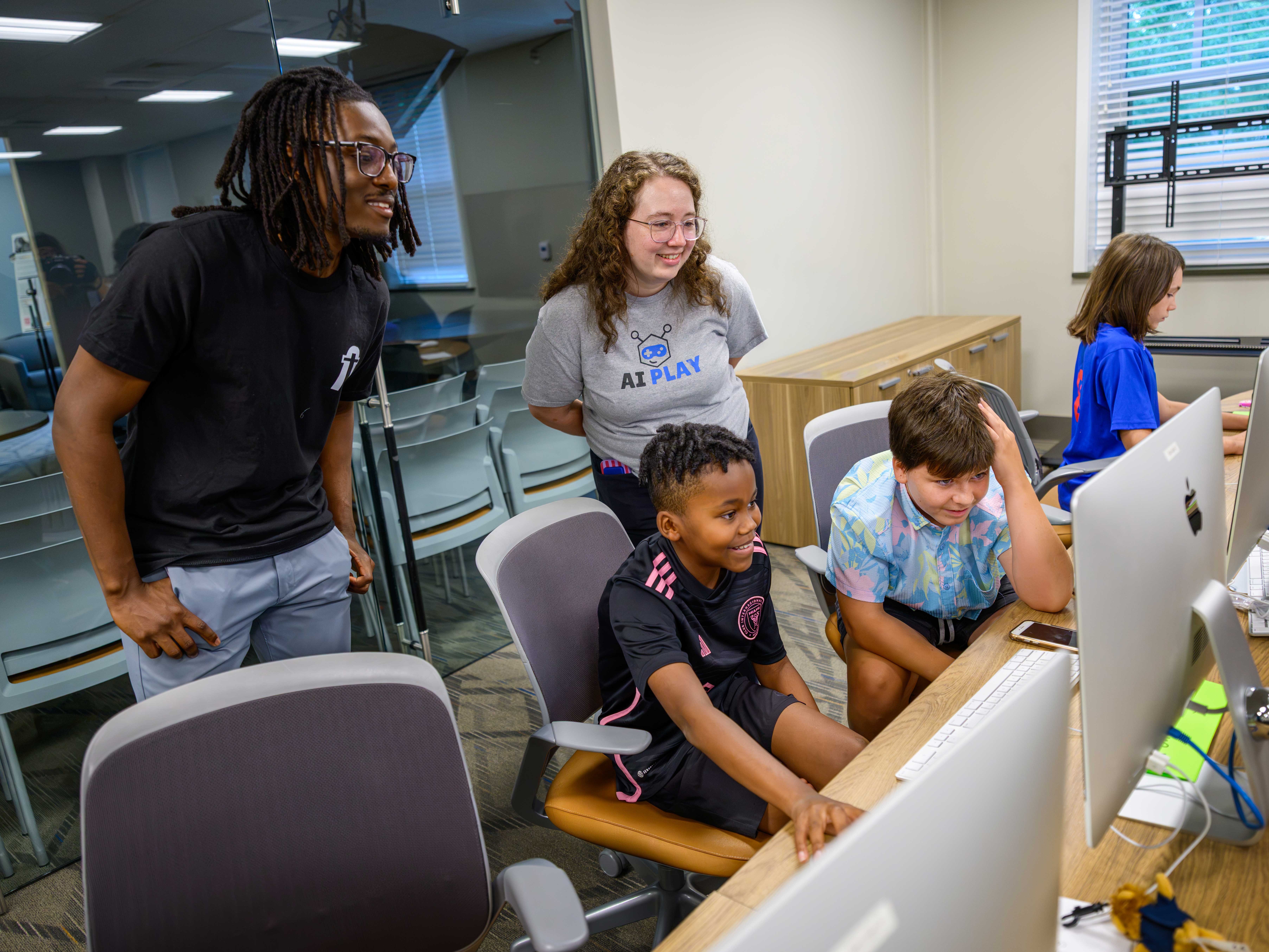
Nearly two dozen Charlotte-area middle schoolers spent a week diving into artificial intelligence and computer science during the inaugural AI Play Summer Day Camp at Queens University of Charlotte.
The weeklong program from July 20-24 brought rising sixth through eighth graders to campus for an immersive exploration of artificial intelligence and computer science.
Led by Assistant Professor Alexis Goslen in the Department of Computer Science at Elon the program offered local youth a hands-on introduction to the rapidly evolving tech landscape.
“Students are coming into contact with AI a lot more than ever before, so understanding it is becoming essential,” Goslen said. “They already have really interesting, profound perspectives on how they use these tools. Our goal was to get them to understand the vocabulary of AI, beyond just generative models like ChatGPT, so they can walk away as informed, critical users of the technology they interact with every day.”
Structured around core AI principles, daily lessons broke down complex computer science concepts into interactive, high-energy challenges. Students explored robotic perception through a “robot relay” to learn how autonomous systems sense and navigate physical environments in real time, while a hands-on candy-sorting exercise modeled machine learning and neural network decision-making.
Interactive discussions guided campers through AI ethics and data privacy, focusing on algorithmic fairness and responsible technology use, before they put their newfound knowledge into practice by designing and coding their own digital game projects throughout the week.
For middle schoolers like Cooper Ryan of Oakridge Middle School, the camp offered a deeper look at the digital footprint people leave behind every day.
“When I heard about the AI Play Camp, I thought it was pretty cool and wanted to check it out,” Ryan shared. “The more I learned about it, the more it surprised me. I never knew how AI tracks your data and how much it actually knows about you.”
The message hit home for campers like Julian Taylor, a rising seventh grader at Charlotte Country Day School, who walked away with a clearer picture of how artificial intelligence operates.
“I’ve always been intrigued by AI and how it works, so I knew I wanted to do this camp,” Taylor said. “I liked learning about how AI computes everything and that it doesn’t think like a human. I used to think it could just get whatever it wanted from the web, but now I know it can only do what it’s been taught and trained to do.”
For university leaders, hosting the middle schoolers was an opportunity to highlight the rapid innovation and responsibility that comes with emerging tools.
Kenitra Horsley, chief operating officer at Queens, shared her personal trajectory in technology with the campers, tracing her path from U.S. Central Intelligence Agency to serving as chief information officer at Queens, and ultimately into her executive role as chief operating officer.
“When I was in school, there were no smartphones, no AI, and no ChatGPT,” Horsley told the students. “My journey into tech started in high school just like yours is starting today, by being curious, trying something new, and exploring different areas of technology to see how it works.”
Horsley emphasized that university administrators and professors are working alongside students to navigate the rapid evolution of tools like artificial intelligence.
“Even in higher education today, we are actively navigating how to use AI. The goal isn’t to suppress it or ban it, but to leverage it smartly,” Horsley noted. “AI can handle research and process data far faster than we can on our own, but the real key for students is using it as a tool while continuing to build their own critical thinking skills.”
The camp also featured interactive sessions led by Elon alumni currently working in Charlotte’s growing technology sector.
Joshua Mason ‘25, a recent graduate and founder and CEO of FaithlineAI, led a workshop where middle schoolers built interactive AI agents from scratch.
“Instead of just talking about AI, the campers built it,” Mason said, noting that students created over 70 working AI agents in a single day, ranging from custom game avatars to interactive rap battles. “My biggest hope is that they leave believing they can build with it, not just use it.”
Joining Mason was fellow Elon alumnus Luke Freudenthal ’23, a computer science graduate currently working as an AI-first operations engineer at Charlotte-based software firm Bluefields Specialty, an insurance technology company. Freudenthal led a session centered on pattern recognition, helping campers understand the distinct capabilities of human intuition versus machine logic.
“Pattern recognition is core to developing strong problem-solving skills,” Freudenthal said. “I broke down the differences between our strengths as human beings and how artificial intelligence works differently.”
The rapid growth of artificial intelligence formed a central theme of the camp’s discussions. Unlike previous technological shifts, the current wave of generative AI and automated decision-making is accelerating at an unprecedented rate.
“Historically, technology moves gradually, but AI is growing on a rapid ‘hockey stick’ curve unlike anything we’ve seen before,” Horsley shared with the young campers. “While it’s hard to imagine exactly where it will be in 10 years, I believe it will make things better, especially in fields like medical research. With the right checks and balances in place, the possibilities for positive impact are enormous.”
“Technology is an enabler. It helps us improve, grow, and see things faster, but it should ultimately be used for the greater good. My hope for this next generation is that they ask challenging questions, stay curious, and find new, creative ways to leverage these tools to solve real-world problems.”
As artificial intelligence continues to transform the modern world, Goslen said, initiatives like AI Play help bridge the gap between abstract computer science concepts and everyday life.
“It’s really exciting to see young people develop that vocabulary and confidence,” she said. “They get to learn about these concepts here, take those conversations home to their families, and carry that understanding forward into whatever they do next.”