Google DeepMind Unveils Three Next-Gen Robotics AI Models - thelec.net
High confidence: full text extraction produced 3548 characters.
Google DeepMind has unveiled its next-generation robotics artificial intelligence (AI) models: Gemini Robotics 2 and Gemini Robotics ER 2.
According to Google, the two models are designed to support complex real-world tasks by enhancing whole-body robot control and embodied reasoning capabilities.
Gemini Robotics 2 is a Vision-Language-Action (VLA) model capable of controlling an entire robot body, including legs and feet, rather than only the upper body. It is designed to operate across a range of robotic platforms. Google said the model’s improved whole-body control enables robots to combine mobility and manipulation in a single task.
The model can understand natural-language instructions and execute multi-step tasks while adapting to changes in the environment during execution. Google said it supports fine finger manipulation, allowing robots to perform tasks such as sealing zip-top bags, tying trash bags, and replacing light bulbs. It can also handle precision assembly work on industrial robots equipped with two-finger grippers.
Gemini Robotics 2 is designed for deployment across different robot form factors, including humanoid robots, dual-arm robots, and industrial manipulators. Google said it improved the versatility of its robotics foundation model (RFM), allowing a single base model to be applied to a variety of robot hardware platforms.
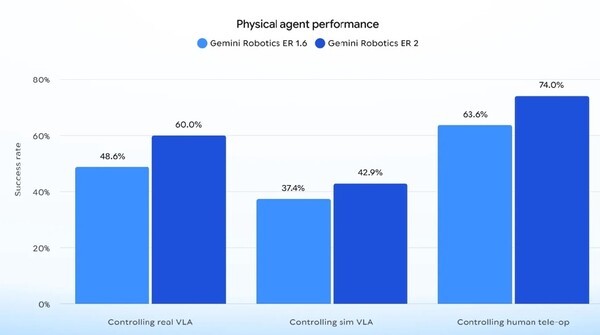
Google also introduced Gemini Robotics ER (Embodied Reasoning) 2, a higher-level reasoning model for robots. The company said the model enables robots to understand their surroundings and create plans for long-duration, complex tasks, including multi-step operations that can continue for several minutes. It is also designed to recognize errors that occur during execution and resume subsequent procedures accordingly.
The model additionally supports multi-robot collaboration, allowing multiple robots to share a common objective and divide work among themselves.
Google also announced an on-device model. Gemini Robotics On-Device 2 is a VLA model that runs locally on robotic devices without an internet connection. Google said it can be adapted to new robot types within hours.
Safety features have also been strengthened. Gemini Robotics 2 is designed to detect human proximity and maintain safe distances, while automatically stopping operation when hazardous situations are identified. The system can also refuse unsafe commands or request human intervention.
Google said it demonstrated Gemini Robotics 2 on multiple robotic platforms, including Apptronik’s Apollo 2 humanoid robot. Demonstrations included tasks that combined whole-body movement with object manipulation, execution of natural-language instructions, and completion of multi-step task sequences.
For example, when Apptronik’s Apollo 2 humanoid robot was instructed to “put the watering can into the green bin on the bottom shelf,” the robot understood the request, walked to a table, picked up the watering can, moved to the shelf, and placed the object accurately in the designated location. While acknowledging that robot mobility still requires improvement, Google described the demonstration as a significant step toward performing real-world tasks that require coordinated whole-body movement.
Gemini Robotics ER 2 is available through a private preview in Google AI Studio and the Gemini Enterprise Agent Platform. The VLA and on-device models are being provided to early-access partners. Google said it plans to validate the models’ performance in real-world environments with a range of partners.