As AI seeps into classrooms, Charleston school district prepares teachers for what’s next - Post and Courier
High confidence: full text extraction produced 11324 characters.
NORTH CHARLESTON — For years, Bonnie Knighton watched some of her students fall behind in science class. She noticed how her English-language learners and students with disabilities often struggled to keep up with complex scientific vocabulary.
Last spring, she began experimenting with artificial intelligence tools to help bridge that gap, after seeing other teachers share ideas on social media.
“If I see something, I’m like, ‘Oh, that’s really cool, will it work for my kids?’ ” she said.
Knighton used an AI tool to translate lessons into students’ native languages and adapt materials so more students could understand them.
For instance, to help kids learn about the solar system, she used a tool to turn the planets into a “social media Kardashian-ish type of thing,” where each planet was a family member with relationships and interactions like a pop culture, reality-TV family.
“The kids loved it,” she said. “If I can connect on that level and use AI with my creativity, my (students’) engagement is going to go up.”
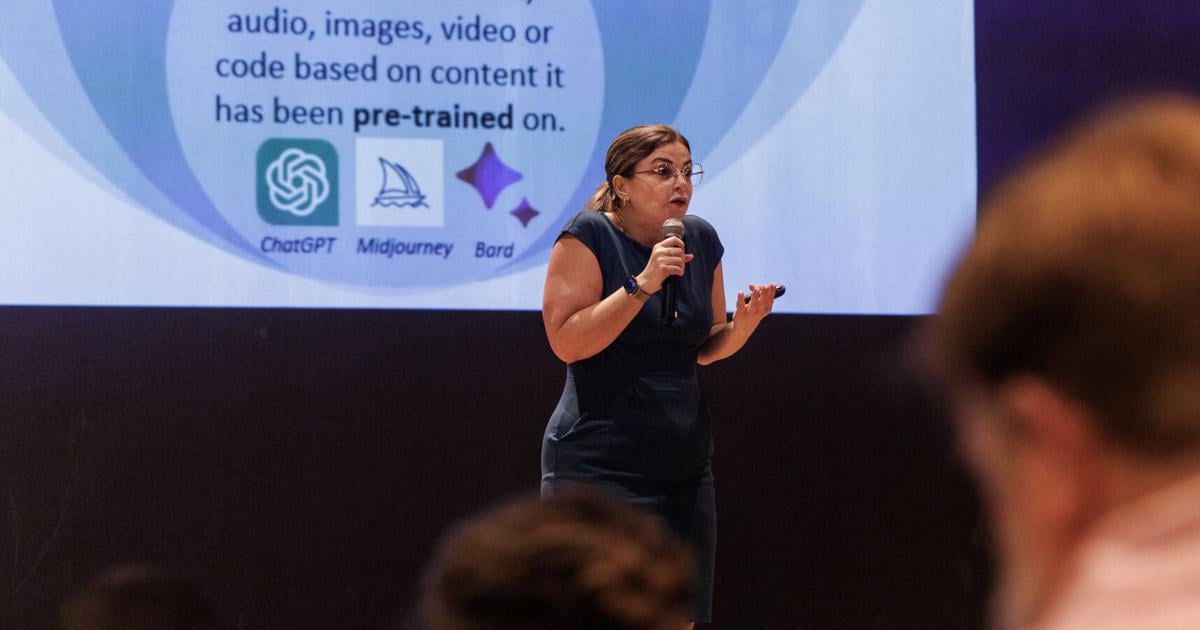
On a sunny July afternoon, Knighton stood before a room of fellow educators, demonstrating how she uses AI to adapt lessons and help students access the same content regardless of their language proficiency or learning needs.
What she taught her colleagues is part of a broad shift underway in the Charleston County School District to prepare educators and students to deploy AI in classrooms during the 2026-27 academic year.
The effort was on full display as the district devoted more than a dozen sessions at its three-day annual professional development event to AI literacy and classroom application, training teachers who will help bring best practices to their classrooms.
The local push to train educators comes amid broader debates over the role of technology in schools. While supporters say AI can help personalize instruction and improve efficiency, critics worry about accuracy, privacy, academic integrity and the cognitive risks of students becoming over-reliant on the tools.
An intentional approach
The district decided to implement a formal strategy to address AI because parents and others were already talking about how it was being used in classrooms, in Charleston County and elsewhere, Chief Financial Officer Daniel Prentice said.
“The superintendent decided: ‘Let’s not contemplate and let’s just do,’ ” Prentice said.
District officials quickly realized they needed help in developing a strategy, as the technology is rapidly evolving and South Carolina lacks clear guidance for districts, Prentice said.
Officials contacted AI for Education, a consulting organization that helps school districts nationwide adopt generative AI responsibly. Officials tapped the organization because they wanted a partner without any business interest steering them toward a particular product, Prentice said.
Corey Crouch, chief program officer at AI for Education, said district leaders wanted an intentional approach rather than one that merely was a reaction to current challenges and opportunities around AI use.
“When we're thinking about a district or an institution like CCSD, there has to be a lot of conversation about the why and to what end? How do we leverage (AI) to prepare our young people for the future, support our teachers and all of those components?” she said. “It's really about having clarity about how this can advance what we're trying to accomplish for our students.”
The district developed its plan in two phases. First, they spoke with parents, teachers and Charleston community members with an interest in technology and education. Those meetings helped inform a new AI policy that the school board approved in January.
The policy is meant to ensure safe, effective and ethical AI use. It states that schools may use AI-powered technologies to enhance teaching and student learning. Teachers using the tools must educate students on appropriate and responsible use.
As part of the effort, the district’s information technology department conducted an internal audit and discovered that many teachers and students already were using generative AI tools like MagicSchool.ai, ChatGPT and Google Gemini in the classroom before policies were in place.
The district signed a one-year contract with MagicSchool.ai, a generative AI tool used to create and assess assignments and give students real-time feedback. Other large school districts, including in Greenville and Horry counties, also have authorized its use.
In Charleston, AI tools will be limited to middle and high school students, officials said.
A handful of local schools began piloting the tool last school year. District officials will evaluate how much it is being used and how effective it is to determine whether to extend the contract, Prentice said.
Overall, the district has invested roughly $310,000 in its AI initiative, including $210,000 for its contract with MagicSchool.ai.
Prentice said the district made sure vendors such as MagicSchool.ai and Google met data privacy and security requirements. Prompts and inputs from within the district cannot be used to train AI models, and teachers and staff have been warned not to include students’ names or any identifying information in the tools.
Phase two is underway for teacher and student training.
S.C. Department of Education officials are speaking with districts across the state to gauge how AI is being used and what policies and safeguards are in place. Student safety, data privacy and cybersecurity remain priorities as the department also studies what technologies best strengthen learning and student performance.
“Technology should be a tool that enhances teaching and learning, not a substitute for the knowledge, skills and human relationships that drive student success,” said department spokesperson Kinard Lisbon told The Post and Courier.
Training teachers
One priority of the Charleston district is to teach everyone involved to make appropriate decisions about AI, said Deputy Superintendent Lucas Clamp. This has been done gradually, starting with school staff.
Last spring, the district provided AI training for principals and teacher leaders. Some teachers also participated in an AI literacy in education course at Clemson University.
Next steps include an online course for teachers and students to help them use district-approved AI tools appropriately, Clamp said.
As part of the effort, the district used this year’s educator symposium to introduce more teachers and staff to AI tools, potential classroom uses and how Charleston students are encountering the technology.
During one session, teachers reviewed feedback from student focus groups that the district and AI for Education conducted during the 2025-26 school year.
The responses, from kids at different grade levels, showed a broad spectrum of beliefs. Some students voiced strong disdain for AI; others feared how it can be used for harm; others still admitted to using it to cheat on assignments.
As teachers discussed the responses, some saw their own uncertainty reflected back at them.
"I feel like their experience kind of aligns with mine,” a teacher said during the session. “I don't know when to use it; I don't always know how to use it. We're kind of in the same boat."
Broader concerns
While district leaders and some educators see opportunities for AI to support learning, the technology has raised concerns among local families and community members in online discussions. Some question whether schools should encourage AI use at all.
Rosie Herold, a K-8 librarian at James Simons Montessori, said she has included teaching about AI in her media literacy lessons. She also has used tools like MagicSchool.ai to turn a concept into a song that kids can easily remember, for instance.
Herold said it’s important for teachers, students and parents to understand the basics of how AI models are trained and work, as well as their abilities and limitations. Otherwise, schools risk more learning loss through overreliance on the technology, she said.
She sees the district’s effort to streamline AI as an opportunity to educate families by sending home one-page handouts or organizing parent nights to discuss how schools are using the tools.
District officials stressed that their approach doesn’t seek to replace a teacher’s instruction or remove friction from student learning.
“We want our students to be critical thinkers, to continue to communicate orally and in writing with their peers, to solve complex problems,” Clamp said. “We are not asking technology to do that for us. The integration of a new technology, we believe, has the opportunity to enhance that environment, but not replace it.”
Clamp also advised parents to get involved, be mindful of their kids’ activities and speak to them about their use of AI. He urged them to share concerns with teachers and administrators.
Finding the balance
The district’s approach reflects a broader shift in education, as districts nationwide grapple with how to leverage new technologies.
Victor Lee, an education professor at Stanford University, said AI has the potential to meaningfully support K-12 education only when districts focus on three things: ensuring that all kids — regardless of background — know what AI can or cannot do; making sure its use actually leads to better instruction; and continuing conversations about its use.
“(Engaging) multiple stakeholders from students to various industry sectors in the area is a very sensible move, and one I would recommend,” Lee said. “I get the sense that (Charleston) is taking a cautious and deliberate approach in this, and (they) are aware that that use has already been happening organically.”
Lee, whose research involves designing learning experiences and resources for AI literacy in K-12 education, said a thoughtful understanding of AI is needed across subject areas and grade levels. While some students might not use these tools in the classroom, they may encounter AI during recess, after school or at home. Without supervision, students could over-rely on chatbots and undermine their cognitive skills, share private personal data or develop emotional dependencies, among other issues.
“I would hope that (Charleston) is thinking carefully and purposefully and they’re establishing goals and clear messages for this,” he said. “Otherwise, it could end up just morphing in many different ways that go against what they’re trying to support.”
Districts also must focus on how to give educators ongoing support, not just one-and-done AI training, said Pati Ruiz, director of learning technology research at Digital Promise, a bipartisan nonprofit created by Congress in 2008.
Ruiz agreed that the district can’t just ignore AI’s existence.
“Schools have a responsibility to help students and teachers understand it, but teaching about AI does not always require students to actively use generative tools,” Ruiz said.
Instead, she favored using case studies and examples of responsible AI use, as well as “think-alouds” where teachers can show how they evaluate AI outputs.
The district’s strategies will be tested when students return to classrooms in August and choices are made about how AI fits into everyday instruction. For now, the focus is on giving teachers the knowledge they need to make those decisions.