Meta leads M7 with a 15% weekly gain; AI computing infrastructure to reach 14GW by 2027—Is this optimism ahead of fundamentals or the start of a re-rating? - Moomoo
High confidence: full text extraction produced 5718 characters.
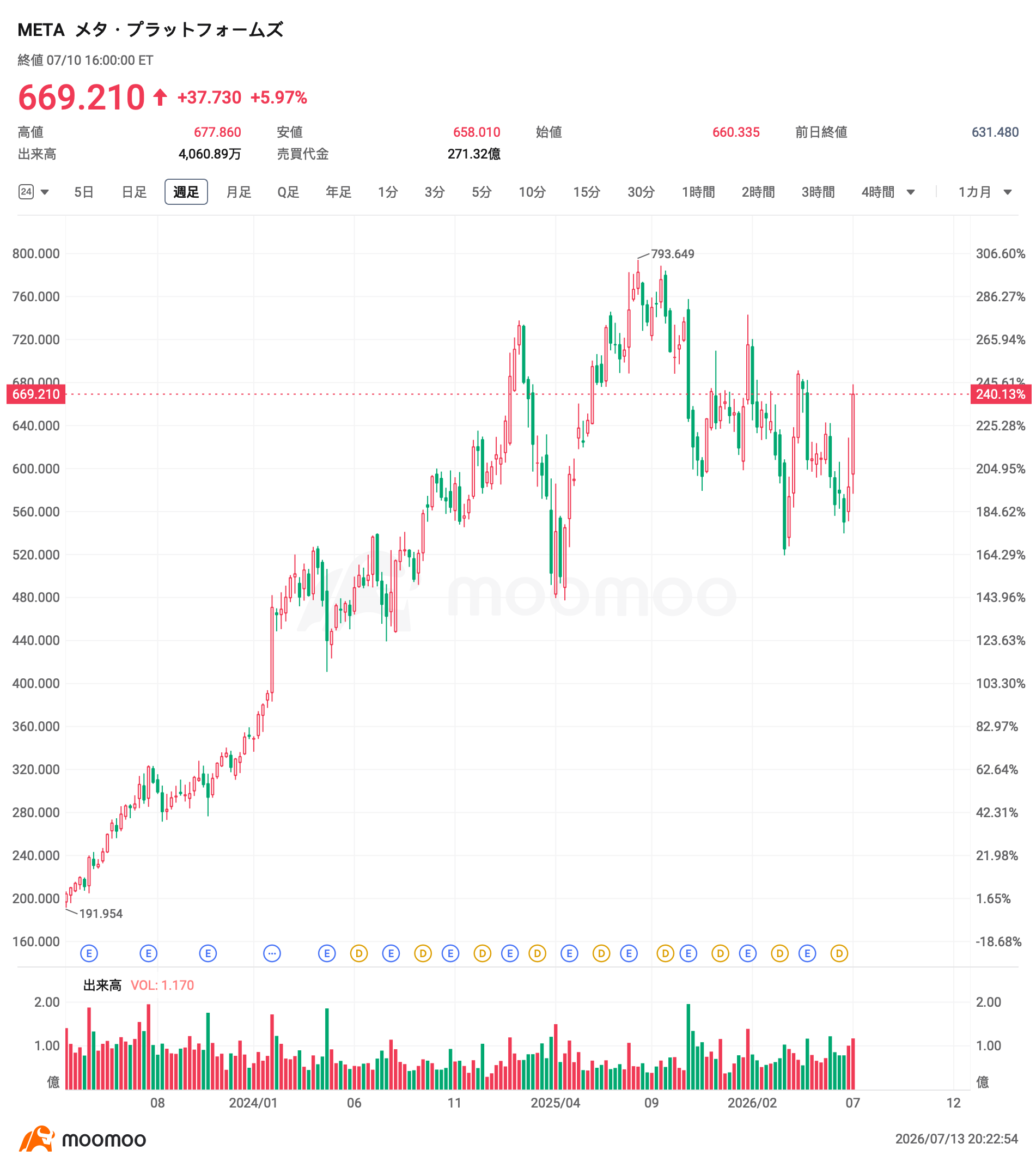
In the U.S. stock market from July 6–10, $Meta Platforms (META.US)$rose 14.8%. $NVIDIA (NVDA.US)$, outperforming the 8.3% gain of $Roundhill Magnificent Seven ETF (MAGS.US)$ and becoming the top weekly gainer among the M7.
The catalyst wasn’t just new AI models. What caught the market’s attention was the emerging path toward monetizing Meta’s massive AI investments—previously viewed with caution as mere 'expenses.'
What drove the stock price higher?
There were three major catalysts behind this rally.
First, Meta’s own Provide AI computing capacity to external companiesReports indicate it is considering launching a cloud business.
Meta has thus far built out its AI data centers primarily to support its own operations, such as ad delivery, content recommendation, and generative AI services. If it can also sell its computing capacity and AI models externally, it may be able to improve facility utilization and develop a revenue stream similar to Amazon's AWS or Microsoft's Azure.
The second factor was announced on July 9:the AI models "Muse Spark 1.1" and the "Meta Model API"in preview.
Developers will now be able to access Meta’s models via an API, and Meta has also set lower pricing than its competitors. Mark Zuckerberg’s post on X—the first in nearly three years—was specifically to announce these new models and the API.
The third point isAI computing capacity expansion plans。
According to internal documents reviewed by Reuters, Meta plans to increase its AI-focused computing capacity to 7 GW by 2026 and further to 14 GW by 2027. The company also announced its intention to begin mass production of its in-house AI chip, 'Iris,' starting in September 2026.
In other words, Meta is moving toward becoming a comprehensive AI infrastructure company—controlling everything from models to chips, data centers, networks, and APIs—in-house, rather than just being a model developer.
SemiAnalysis's forecast of a 'computing capacity reversal'
Research firm SemiAnalysis identifies three key factors shaping the AI race:data, talent, and computing capacityas the three critical elements.
According to the firm’s estimates, Meta’s AI computing capacity could surpass that of OpenAI and Anthropic by the end of 2026. The report also outlines plans for five large-scale clusters each exceeding 1 GW of capacity, as well as a vision to interconnect sites located up to approximately 2,000 kilometers apart.
However, it should be noted that this projection comes from SemiAnalysis and is not an official forecast from Meta. Moreover, greater computing capacity does not automatically translate into superior model performance, user numbers, or revenue compared to competitors.
What matters is how efficiently Meta can operate its massive computing infrastructure at high utilization rates and reduce the cost per inference.
If Meta can sell its excess computing capacity—beyond what it needs for its own services—to external customers, its AI infrastructure could transform from a mere cost center into a revenue-generating asset.
Bullish and cautious scenarios
In the bullish scenario, Meta’s AI investments would be recouped through two channels.
One is growth in existing businesses driven by improved ad targeting and content recommendation accuracy. The other is external revenue via Meta Model API and cloud services. Additionally, if the share of in-house chips like Iris increases, Meta could reduce its reliance on external GPUs and potentially lower the cost of delivering AI services.
On the other hand, there are also many reasons for caution. The API and cloud businesses have not yet reached a stage where customer numbers or revenue scale can be confirmed. If price competition intensifies, even growing usage may not translate into sufficient profitability.
Moreover, expanded capital expenditures will lead to higher depreciation, power costs, and data center operating expenses. If AI-related revenues take time to materialize, pressure on operating margins and free cash flow is likely to re-emerge as a market concern.
The recent stock price rally does not confirm 'victory in the AI race.' Rather, it reflects the market assigning a concrete valuation for the first time to the potential of recovering these investments.
Narrow the supply chain down to three key areas first
Simply listing a broad range of Meta-related AI stocks won’t lead to actionable investment decisions. What investors should focus on is which specific components will see increased demand as Meta scales its infrastructure from 7GW to 14GW.
⚫︎ GPU: $NVIDIA (NVDA.US)$ 、 $Advanced Micro Devices (AMD.US)$
This is the segment where the largest amount of capital flows due to the expansion of AI computing capacity. However, if Meta accelerates adoption of its in-house chip Iris, increased computing capacity may not necessarily translate directly into higher external GPU purchases.
⚫︎ In-house AI chips: $Broadcom (AVGO.US)$、 $Taiwan Semiconductor (TSM.US)$
Broadcom is involved in Meta's custom semiconductor development, while TSMC handles manufacturing. If mass production of Iris proceeds as planned, it will relatively directly reflect an increase in the proportion of in-house chips. However, we need to confirm the timing of mass production, yield rates, and actual scale of deployment.
⚫︎ AI networking: $Arista Networks (ANET.US)$
In massive AI clusters, processing performance depends not only on the number of GPUs but also on high-speed networking that connects servers. The importance of networking will grow if plans to integrate multiple data centers progress further, though future order volumes have not yet been disclosed.
This article uses partial automatic translation.
—moomoo News Citron
3
3